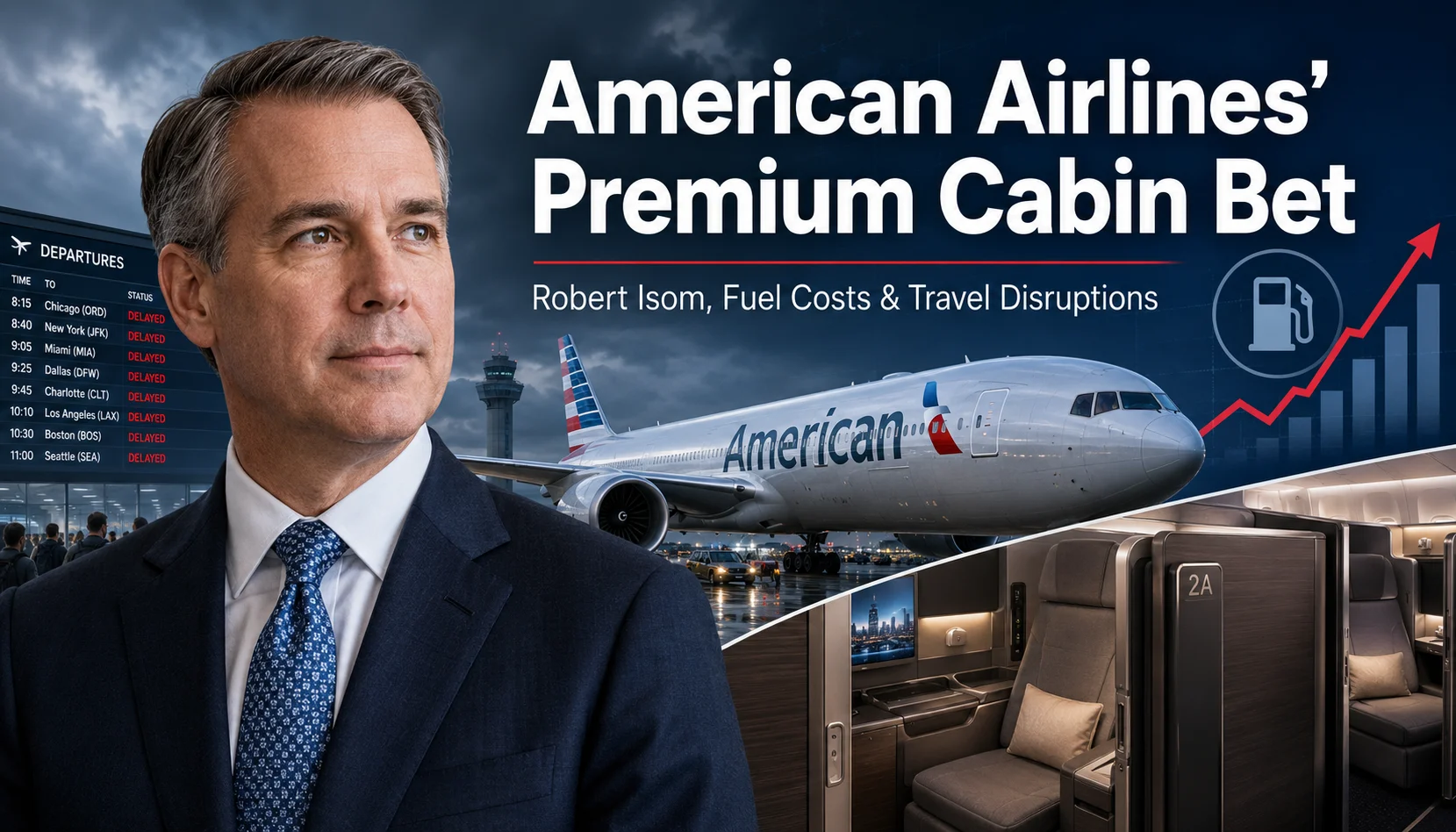
Robert Isom’s Premium Cabin Bet: Why American Airlines Is Adding Suites While Fuel Costs Bite
American Airlines’ premium-cabin expansion is best understood as a revenue shield against higher fuel costs and competitive pressure. Its real defense against travel disruption is not bigger cabins by themselves, but stronger operations, better digital recovery tools, improved connectivity and hub scheduling.
The easy headline is that American Airlines is “aggressively expanding premium cabins to combat surging fuel costs and shield passengers from travel chaos.” The sharper version is more useful: Robert Isom’s American Airlines is trying to make more money from the passengers most willing to pay for comfort, status and certainty — while separately investing in the systems that help travelers recover when flights go sideways.
That distinction matters. A privacy door cannot stop a thunderstorm. A lie-flat seat does not clear an air traffic control delay. But premium cabins can raise unit revenue, strengthen loyalty, attract corporate travelers and help offset a fuel bill that has become much harder to ignore.
As of May 29, 2026, American’s own financial updates and recent Reuters reporting point to the same strategy: defend margins with premium revenue, corporate demand and loyalty while improving the customer experience enough that travelers choose American even when fares are higher.
What happened: the headline behind the latest airline news
American is moving on three fronts at once.
| Claim | What the verified picture shows |
|---|---|
| American is expanding premium cabins | True. The airline is adding Flagship Suite seats, Premium Economy seats, refreshed lounges, retrofits and new aircraft interiors. |
| Fuel costs are pressuring the airline | True. American has said higher jet fuel prices are expected to add more than $4 billion in expense in 2026, and Reuters reported Robert Isom discussed a $4 billion to $5 billion fuel-cost hit. |
| Premium cabins “shield passengers from travel chaos” | Overstated. Premium services can improve the airport and onboard experience, but disruption protection comes from operations, rebooking tools, schedule design, communications and airport execution. |
| This is only an American Airlines story | No. U.S. airlines are broadly chasing higher-yield customers as fuel costs rise and demand remains resilient. |
This is not just a cabin refresh. It is a bet on a different revenue mix.
American reported record first-quarter 2026 revenue of $13.9 billion, but also a GAAP net loss of $382 million. The company said the midpoint of its full-year outlook was roughly flat with 2025 despite more than $4 billion of additional expense tied to higher jet fuel prices. Isom framed the revenue momentum around four commercial priorities: improving the customer experience, expanding the global network, growing premium revenue and leading in loyalty.
That is the key sentence hiding inside the news. Premium cabins are not decorative. They are part of the math.
Robert Isom’s real message: revenue has to outrun fuel
Robert Isom has been CEO of American Airlines Group and American Airlines since March 2022. His 2026 challenge is blunt: American has to prove that its product, network and loyalty strategy can generate enough revenue to absorb higher fuel costs, labor costs and competitive pressure.
Reuters reported on May 27, 2026, that Isom told a Bernstein investor conference American was not changing its full-year outlook even as fuel prices were expected to add $4 billion to $5 billion to costs. The reason: stronger revenue, premium demand, corporate travel and leisure demand were helping cushion the hit.
That does not mean American is insulated. Its 2026 adjusted earnings outlook still ranged from a loss of $0.40 per share to a profit of $1.10 per share after an earlier reduction. That range is a reminder that the premium strategy is not a victory lap. It is a recovery plan.
The most important line for investors and travelers is this: American’s premium push is not merely about luxury. It is about yield. If the airline can persuade more customers to buy up into Flagship Business, Premium Economy, paid upgrades, lounge access, loyalty-linked perks and better-connected itineraries, it can earn more revenue without simply adding more low-margin seats.
That is why premium demand has become so valuable in a high-fuel-cost environment. Fuel is largely outside the airline’s control. The revenue mix is not.
Why premium cabins matter more when fuel gets ugly
Airlines do not beat expensive fuel by wishing it away. They respond with a mixture of fare increases, capacity discipline, route decisions, loyalty revenue, cost control and higher-yield products.
Premium cabins help because they change the economics of the same aircraft. A lie-flat suite takes up more space than a standard economy seat, but it can also command a much higher fare. Premium Economy sits in the middle: not full business class, but a paid step-up for travelers who want more space without buying the front cabin.
American said in its first-quarter 2026 update that lie-flat and Premium Economy seats grew more than twice as fast as Main Cabin seats. The airline also said premium unit revenue continued to outperform Main Cabin, while managed corporate revenue rose 13% year over year.
That is the business case in plain English: American wants more of its seats to be seats people actively pay extra to choose.
The industry context supports the move. Reuters reported that Southwest, historically famous for a simpler cabin model, was also exploring broader premium options while fare increases helped offset fuel pressure. When even Southwest is talking about more premium choices, the market signal is hard to miss: U.S. airlines are trying to monetize preference, not just transportation.
What American is adding: suites, premium economy, lounges and Wi-Fi
American’s premium push did not begin with the 2026 fuel spike. The airline announced its Flagship Suite plan in 2022, saying premium seating in its long-haul fleet would grow more than 45% by 2026. The plan included privacy-door Flagship Suite seats on new Airbus A321XLR and Boeing 787-9 deliveries, plus retrofits of Boeing 777-300ER aircraft.
The seat counts matter because they show this is a fleet-design strategy, not a one-route gimmick.
| Aircraft / product | Premium configuration or change |
|---|---|
| Boeing 787-9 | 51 Flagship Suite seats and 32 Premium Economy seats |
| Airbus A321XLR | 20 Flagship Suite seats and 12 Premium Economy seats |
| Boeing 777-300ER retrofit | 70 Flagship Suite seats and 44 Premium Economy seats planned in refreshed interiors |
| Long-haul fleet | Premium seating targeted to grow more than 45% by 2026, according to the original Flagship Suite announcement |
In May 2025, American put the new Flagship Suite seats on sale and announced early routes for the newest Boeing 787-9 aircraft. The first international Flagship Suite service was scheduled from Chicago O’Hare to London Heathrow on June 5, followed later by Philadelphia–London, Philadelphia–Zurich and Dallas Fort Worth–Brisbane service. American also said it expected 30 new 787-9 aircraft to join the fleet between 2025 and 2029 and projected lie-flat and Premium Economy seating growth of 50% by the end of the decade.
The cabin product is only one layer. American is also building the premium feeling around the cabin: lounges, priority services, upgraded onboard experience and connectivity.
On May 26, 2026, American announced it would install Starlink Wi-Fi on more than 500 narrowbody aircraft beginning in the first quarter of 2027. That matters because premium perception is no longer limited to the seat. Business travelers increasingly judge an airline by whether they can work, message, stream and recover from disruption in real time.
Travel chaos: what actually protects passengers
The weakest part of the viral-style headline is the idea that premium cabins shield passengers from severe travel chaos. They do not — at least not by themselves.
Premium passengers may get priority check-in, priority boarding, lounge access, faster service recovery in some cases and a calmer place to wait. Those are real advantages. But they do not eliminate the underlying causes of disruption: storms, airport congestion, air traffic control constraints, aircraft availability, crew positioning, maintenance and schedule fragility.
American’s own recent updates are clearer about what actually helps during irregular operations.
For summer 2026, American highlighted new digital tools that explain the reason behind delays and cancellations, offer self-service rebooking, provide bag tracking and issue digital vouchers through the app. The airline also pointed to Connect Assist technology, free Wi-Fi for AAdvantage members on nearly every flight, and TSA PreCheck Touchless ID availability at 60 airports.
American has also focused on schedule structure. In its first-quarter 2026 report, the airline said it was “rebanking” Dallas Fort Worth International Airport, its largest hub, and Philadelphia to reinforce operational reliability and improve connectivity. In its summer 2026 operations update, American said FAA action to bring Chicago O’Hare schedules back within operational capacity should support fewer congestion-driven delays and a more predictable operation.
That is the real disruption shield: not just nicer seats, but better information, more flexible self-service tools, more resilient schedules and a network that is less likely to collapse under pressure.
The U.S. Department of Transportation’s Air Travel Consumer Report exists because consumers need comparable information on delays, mishandled baggage, oversales, complaints and other service-quality measures. In other words, reliability is not a soft issue. It is one of the core ways travelers judge airline quality.
The competitive backdrop: American is trying to close a credibility gap
American is not making this move from a position of pure strength. It is trying to regain ground.
Reuters reported in December 2025 that American was “betting big on luxury” to catch up with Delta and United, with new 787-9 and A321XLR aircraft central to the premium strategy. The same report noted that analysts saw the turnaround as slow and costly, with operational reliability still a weak spot and supply-chain bottlenecks delaying some aircraft deliveries and retrofits.
That tension is what makes the story interesting. American’s premium push is both offensive and defensive.
It is offensive because the airline is trying to win higher-paying passengers with better cabins, lounges, connectivity and loyalty perks. It is defensive because American has lagged key rivals in profitability and needs more revenue resilience when fuel, labor and disruption costs rise.
The airline knows the old playbook is not enough. Competing mainly on scale, hub breadth and basic fares leaves an airline exposed when costs jump. Competing on product gives it more ways to earn.
The risk: premium does not solve everything
American’s strategy is logical. It is not risk-free.
First, premium retrofits are expensive and operationally messy. Aircraft need to be taken out of service. Seats, interiors and certification work can be delayed. Supply-chain bottlenecks can turn a tidy investor presentation into a multi-year execution problem.
Second, the demand picture is uneven. Isom has acknowledged what Reuters described as a “K-shaped” pattern, where higher-income travelers outperform middle- and lower-income customers. Premium demand can be strong while some leisure travelers become more fare-sensitive.
Third, passenger trust depends on the whole journey. A beautiful suite helps on a long-haul flight. It does not erase a missed connection, a confusing app notification, a late bag or a two-hour line at customer service.
Finally, premiumization can widen the experience gap. Airlines may improve the front cabin faster than the back. Main Cabin travelers may benefit from better Wi-Fi, more reliable operations and newer interiors, but they may also notice that the airline’s most visible investments are aimed at higher-paying customers.
That is the trade-off American has to manage carefully. A premium airline still has to care for passengers who are not sitting in premium seats.
What this means for travelers
For business travelers and premium leisure passengers, American’s direction is straightforward: more lie-flat suites, more Premium Economy seats, better lounges, stronger connectivity and more reasons to stay inside the AAdvantage ecosystem.
For Main Cabin passengers, the benefits are more indirect but still meaningful. If American’s operational investments work, the improvement should show up in clearer disruption information, better rebooking options, stronger connectivity and more predictable hub performance. Those improvements matter even when your seat does not have a privacy door.
For deal seekers, the news is mixed. If fuel stays expensive and U.S. carriers retain pricing power, fares may remain firm in many markets. A tighter domestic market and reduced discount-carrier pressure can make cheap seats harder to find. At the same time, American still needs to fill a huge network, so the lowest fare has not disappeared. It is just sharing the stage with a bigger upsell machine.
For loyalty members, the message is clear: American wants AAdvantage to be the connective tissue between fares, Wi-Fi, upgrades, credit cards, lounges and repeat behavior. The premium cabin is the most visible part of the strategy, but loyalty is the part designed to keep customers coming back.
Bottom line
American Airlines is not expanding premium cabins simply because suites look good in photos. Under Robert Isom, the airline is trying to rebuild its revenue engine around customers who will pay more for space, reliability, connectivity and status.
The fuel-cost pressure makes that strategy more urgent. The travel-disruption problem makes execution more unforgiving.
The best way to read the latest American Airlines news is this: premium cabins are the revenue shield; operational reliability is the passenger shield. American needs both. If it delivers only the first, travelers may see a nicer airline that still frustrates them. If it delivers both, Isom’s premium bet starts to look less like luxury branding and more like a credible turnaround plan.
FAQ
Is Robert Isom expanding American Airlines premium cabins because of fuel costs?
Partly, but not only because of fuel. American’s premium strategy predates the 2026 fuel spike, but higher jet fuel costs make premium revenue more important as a margin cushion. The company has tied its revenue momentum to customer experience, global network growth, premium revenue and loyalty.
Which American Airlines aircraft are getting Flagship Suite seats?
American has said Flagship Suite seats are included on newly delivered Boeing 787-9 and Airbus A321XLR aircraft, and the airline also plans to retrofit Boeing 777-300ER aircraft with refreshed premium interiors.
Do premium cabins protect passengers from delays and cancellations?
No. Premium cabins can make the experience more comfortable and may include priority services, but they do not prevent storms, air traffic control constraints, crew issues or airport congestion. American’s actual disruption strategy is tied more closely to app tools, rebooking options, bag tracking, schedule design and operational reliability.
What is American doing to improve the travel experience during disruptions?
American has highlighted digital tools that explain delays and cancellations, offer self-service rebooking, track bags and provide digital vouchers. It is also using connection-saving technology, improving Wi-Fi access and adjusting hub schedules at airports such as Dallas Fort Worth, Philadelphia and Chicago O’Hare.
Will Main Cabin passengers benefit from American’s premium push?
Some benefits should reach the whole aircraft, especially Wi-Fi, digital tools, schedule reliability and newer interiors. But the most visible seat and lounge upgrades are aimed at customers willing to pay for premium cabins or premium-adjacent products.
Is American’s premium strategy guaranteed to work?
No. The strategy depends on execution, sustained premium demand, aircraft deliveries, retrofit timing, operational reliability and the airline’s ability to keep customers satisfied across all cabins. It is a credible strategy, but not a guaranteed turnaround.
Sources
- American Airlines Reports First-Quarter 2026 Financial Results — American Airlines Newsroom, April 23, 2026. Used for: Q1 revenue, fuel-cost outlook, premium revenue, corporate revenue, operational initiatives.
- American Airlines sees resilient demand cushioning fuel-price hit — Reuters, May 27, 2026. Used for: Robert Isom’s latest investor-conference comments, fuel-cost pressure, premium demand and 2026 outlook.
- A Private Premium Experience in the Sky: American Airlines Introduces New Flagship Suite Seats — American Airlines Newsroom, September 20, 2022. Used for: Flagship Suite product details, 787-9, A321XLR and 777-300ER premium seating plans.
- American Airlines is ready for a “Suite Summer” as new premium Flagship Suite seats go on sale next week — American Airlines Newsroom, May 2, 2025. Used for: Flagship Suite launch routes, 787-9 configuration, aircraft deliveries and premium-seat growth target.
- American is ready for a record-breaking summer travel season in 2026 — American Airlines Newsroom, May 10, 2026. Used for: summer operational readiness, app tools, rebooking, Connect Assist, Wi-Fi and ORD schedule context.
- American Airlines to install Starlink, the fastest Wi-Fi in the sky — American Airlines Newsroom, May 26, 2026. Used for: Starlink rollout on more than 500 narrowbody aircraft beginning in Q1 2027.
- Robert Isom – Chief Executive Officer — American Airlines leadership bio. Used for: Isom’s current role and leadership background.
- American Airlines ramps up premium upgrades to regain ground on Delta, United — Reuters, December 17, 2025. Used for: competitive context, premium-turnaround framing, challenges and execution risks.
- Air Travel Consumer Reports — U.S. Department of Transportation, last updated May 28, 2026. Used for: official context on consumer-facing airline service-quality reporting.
- Southwest sees no demand hit from fare hikes, eyes broader premium push — Reuters, May 28, 2026. Used for: broader U.S. airline industry context around fuel costs, fare increases and premiumization.