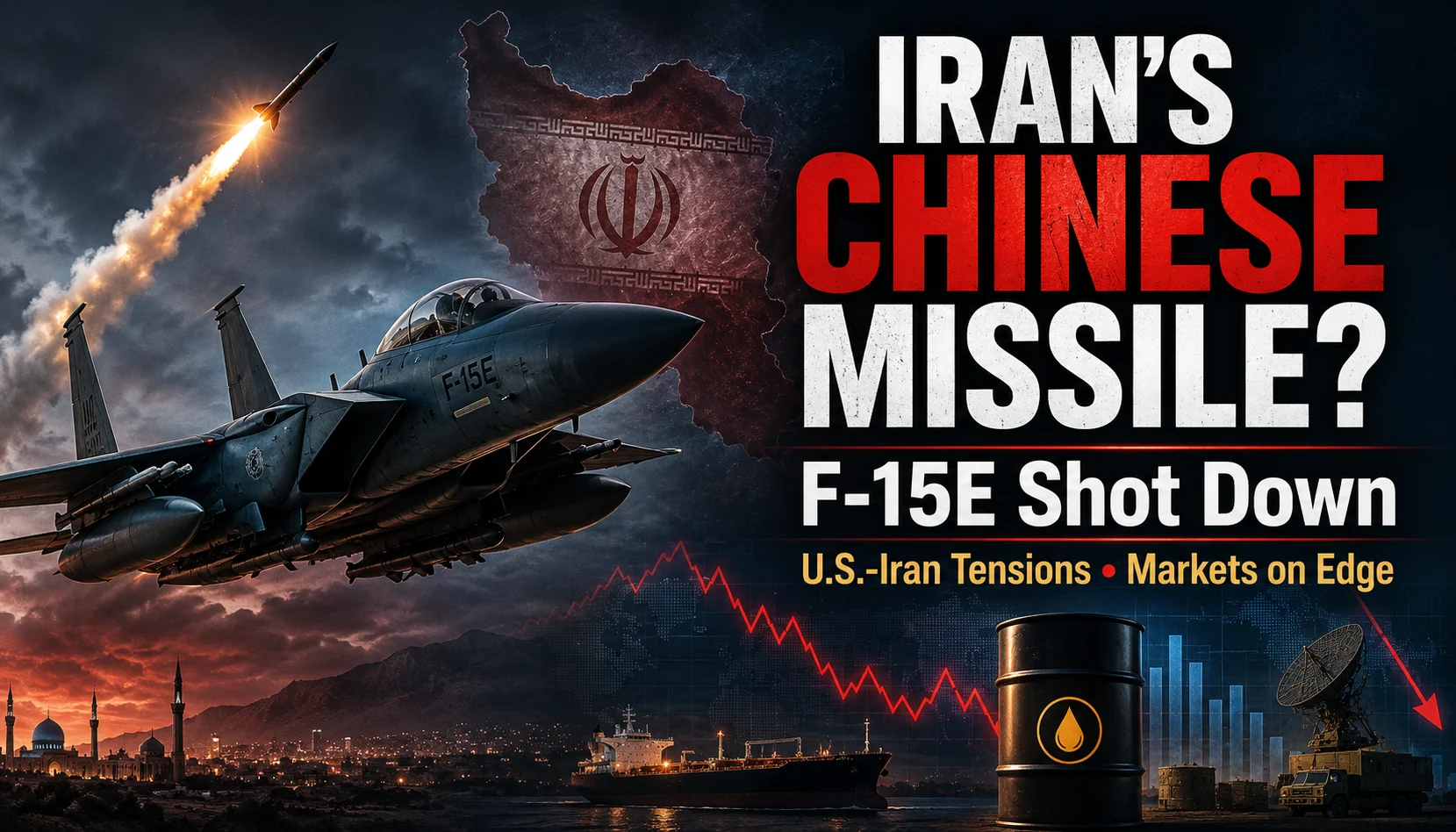
Iran’s Possible Chinese Missile and the F-15 Shootdown: Air Power, U.S.-Iran Tensions, and Market Sectors to Watch
The most important word in the headline is not “Chinese.” It is “may.” If Iran really used a Chinese-made shoulder-fired missile against a U.S. F-15E, the story is not just about one aircraft. It is about how cheap, portable air defenses can complicate expensive air campaigns, pull China into the U.S.-Iran narrative, and push risk premiums across energy, shipping, defense, airlines, currencies, and bonds.
The report that Iran may have used a Chinese-made missile to shoot down a U.S. fighter jet should be read carefully. U.S. official sources confirm that an F-15E Strike Eagle was shot down over Iran and that two American service members were later recovered. The public record is much thinner on the exact weapon used. A report attributed to NBC News says sources assessed that the aircraft was probably hit by a Chinese-made, shoulder-launched missile, but U.S. Central Command has not publicly confirmed that attribution.
That distinction matters. A confirmed Chinese-origin weapon would raise the geopolitical stakes. An unconfirmed Chinese-origin assessment still matters, but for a different reason: it shows how quickly the conflict is moving from a U.S.-Iran military contest into a broader test of supply chains, sanctions enforcement, air-defense proliferation, and market confidence.
This article is a general news and market analysis as of May 30, 2026. It is not investment advice.
What is confirmed, and what is still uncertain?
The cleanest way to read this story is to separate the aircraft incident from the missile-attribution claim.
| Claim | Current status | Why it matters |
|---|---|---|
| A U.S. F-15E was shot down over Iran. | Confirmed by U.S. Central Command and the U.S. Air Force. | This makes the event more than rumor or battlefield propaganda. |
| The two U.S. service members were rescued. | Confirmed by U.S. Central Command and the U.S. Air Force. | The rescue limited the political damage but did not erase the operational shock. |
| The aircraft was probably struck by a Chinese-made shoulder-launched missile. | Reported by sources, not publicly confirmed by U.S. official statements reviewed here. | This is the claim that could pull China deeper into the strategic narrative. |
| China planned or supplied MANPADS to Iran. | Reuters reported that CNN cited U.S. intelligence suggesting China was preparing such shipments; China rejected the reports. | The dispute highlights the gray zone between intelligence assessments, sanctions evasion, and formal state responsibility. |
| The U.S.-Iran ceasefire is stable. | Not settled. Reuters reported continued negotiations, fresh strikes, and U.S. warnings that strikes could resume if diplomacy fails. | Markets are trading the probability of de-escalation, not peace itself. |
U.S. Central Command said U.S. forces completed the rescue of two service members after their F-15E was shot down on April 2 during a combat mission. The U.S. Air Force carried the same statement. The Air Force’s own fact sheet describes the F-15E Strike Eagle as a dual-role fighter designed for air-to-air and air-to-ground missions, with a pilot and a weapon systems officer.
The missile question is murkier. The accessible excerpt of the NBC-linked report says the F-15 was “probably” struck by a Chinese-made shoulder-launched missile. That is a significant assessment, but it is not the same thing as a public forensic finding. Until there is official evidence — wreckage imagery, serial numbers, seeker components, supply-chain documents, or a declassified intelligence assessment — the correct wording is: Iran may have used a Chinese-made missile.
Why a shoulder-fired missile matters more than it sounds
A shoulder-fired missile can sound small beside a modern fighter jet. That is the point.
Man-portable air-defense systems, or MANPADS, are surface-to-air missiles that can be fired by one person or a small team. They are often described as shoulder-fired anti-aircraft missiles. Many use infrared seekers that track the heat signature of an aircraft engine. Their danger is not that they replace integrated air-defense systems. It is that they add uncertainty in places where aircraft may be flying lower, slower, or on predictable routes.
That matters for fighter aircraft in three ways.
First, it compresses the safe operating envelope. A strike aircraft can be technically superior and still face risk during ingress, egress, close air support, search-and-rescue cover, refueling patterns, or low-altitude operations.
Second, it raises the cost of every mission. If commanders have to add more electronic warfare, decoys, escort aircraft, drones, suppression missions, rescue packages, and standoff munitions, the price of each sortie climbs.
Third, it changes the propaganda balance. A single shootdown of a high-value aircraft can become a strategic message: air superiority is not the same thing as invulnerability.
This is why the possible Chinese-origin missile angle is powerful. It is not only a weapons story. It is a supply-chain story.
The China angle: three different possibilities
The phrase “Chinese missile” can mean several different things, and they carry very different implications.
Scenario one: Chinese-made, but old or diverted.
A weapon can be manufactured in one country and later transferred through brokers, third countries, battlefield capture, old stockpiles, or black-market channels. This would still be serious, but it would not automatically prove direct Chinese state involvement.
Scenario two: Chinese-made and recently supplied through intermediaries.
This is the more destabilizing middle ground. Reuters reported in April that CNN, citing U.S. intelligence, said China was preparing to deliver air-defense systems to Iran and route them through third countries to mask their origin. The reported weapons were MANPADS. That kind of pathway would fit the logic of sanctions evasion and plausible deniability.
Scenario three: a state-backed transfer.
This would be the most escalatory reading. It would turn a U.S.-Iran air-war incident into a U.S.-China crisis. Washington would be more likely to use sanctions, export controls, tariffs, diplomatic pressure, and intelligence disclosures. Beijing would likely deny involvement and accuse Washington of politicizing intelligence.
China has already rejected reports that it planned weapons shipments to Iran. Chinese Foreign Ministry spokesperson Guo Jiakun said Beijing opposed what he called groundless smears and said China strictly controls military exports under domestic law and international obligations. A Chinese embassy spokesperson in Washington also denied reports that Beijing planned to supply Iran with air-defense systems.
That denial is not a minor footnote. It is central to the story. The market impact depends not only on whether the missile was Chinese-made, but on whether investors, governments, and intelligence agencies believe the transfer was recent, deliberate, and attributable.
U.S.-Iran tensions: diplomacy is alive, but the risk premium is not gone
As of May 30, 2026, the U.S.-Iran conflict is sitting in an awkward place: negotiations are active, but force is still part of the bargaining language.
Reuters reported that President Donald Trump was weighing a proposal to extend the early-April truce for another 60 days while negotiators tried to work toward a permanent end to the war. But the same reporting said major disputes remained, including Iran’s nuclear capacity and the reopening of the Strait of Hormuz. Reuters also reported that Defense Secretary Pete Hegseth said the U.S. was ready to restart attacks on Iran if no deal was reached.
That is why markets can rally on peace headlines and still keep a war premium. The conflict has not become a simple “risk on / risk off” switch. It is a negotiation backed by military force, with oil, shipping, air-defense supply chains, and U.S.-China relations all sitting inside the same trade.
Market sectors most exposed
The F-15E shootdown is not large enough by itself to reprice the global economy. But it is a signal inside a larger conflict that already has. The market story is about second-order effects.
| Sector or asset class | Likely pressure | What to watch |
|---|---|---|
| Oil and gas | Higher volatility; upside risk if Hormuz stays constrained | Brent crude, WTI, spare capacity, strategic reserve releases |
| LNG | Higher regional risk premium | Qatar flows, Asian import demand, shipping insurance |
| Shipping and tankers | Higher rates and insurance costs during escalation | Tanker day rates, war-risk premiums, rerouting |
| Aerospace and defense | Better demand narrative, but not automatic stock upside | Munitions, air defense, electronic warfare, counter-MANPADS systems |
| Airlines and travel | Negative from fuel costs and flight disruption | Jet fuel, route changes, passenger demand |
| Consumer and luxury | Negative if energy inflation hits real spending | Retail margins, tourism, discretionary demand |
| Asian currencies | Pressure on energy importers | Rupee, rupiah, peso, won, yen, FX reserves |
| Bonds | Pressure from inflation and defense spending expectations | U.S. and European long yields |
| Semiconductors and AI | Can cushion equity indices, especially in Korea and the U.S. | AI capex, memory chips, export controls |
Energy and LNG
The Strait of Hormuz is the central market channel. The U.S. Energy Information Administration estimated that oil flows through the strait averaged 20 million barrels per day in 2024, about 20% of global petroleum liquids consumption. EIA also said around one-fifth of global LNG trade transited the Strait of Hormuz in 2024, primarily from Qatar.
That is why a military headline about one jet can matter to fuel prices. If the incident increases the perceived odds of renewed U.S. strikes, Iranian retaliation, mine-laying, or shipping disruption, it feeds directly into crude, LNG, refining margins, and inflation expectations.
Reuters reported on May 27 that oil’s roughly 40% jump during the Iran war had reshaped inflation and interest-rate expectations. Reuters also reported that oil prices later fell on hopes of a ceasefire extension and reopening of the Strait of Hormuz. This is not a calm market. It is a market trying to price two incompatible futures: a reopened chokepoint or a renewed escalation.
Shipping, tankers, and insurance
Shipping is where geopolitical risk becomes a line item.
Reuters reported that the benchmark cost of shipping crude from the Middle East to China rose from around $130,000 a day before the crisis to more than $500,000 a day at the height of the U.S.-Israel-Iran bombing activity. Even if oil prices fall on diplomatic optimism, tanker rates and insurance can stay elevated if crews, shipowners, and insurers believe the route is still unsafe.
The sectors most exposed here are tanker operators, LNG carriers, marine insurers, ports, commodity traders, and companies with tight delivery schedules.
Aerospace and defense
The obvious assumption is that war helps defense stocks. The actual picture is more complicated.
Reuters reported in April that U.S. defense stocks had declined even as the Iran war dragged on, after an early surge appeared to have peaked. Investors cited early positioning, valuations, long production cycles, and budget concerns. That does not mean the defense sector is irrelevant. It means the clean trade is not simply “war headline equals defense-stock rally.”
The more precise defense-market read is this: demand attention shifts toward survivability. That includes aircraft self-protection, missile-warning systems, directed infrared countermeasures, electronic warfare, suppression of enemy air defenses, standoff weapons, drones, satellite intelligence, combat search-and-rescue systems, and munitions production.
If a portable missile can threaten a sophisticated strike aircraft, the market does not only ask who builds the jet. It asks who helps the jet survive.
Airlines, travel, and consumer sectors
Airlines are hit from both sides: higher fuel costs and disrupted routing. Reuters reported that the S&P 500 passenger airlines index was down more than 6% since the conflict began, while a global luxury basket was down 10% as investors worried inflation could hit spending.
That is the consumer channel. Even when fighting is geographically contained, higher energy costs behave like a tax. They reduce disposable income, squeeze margins, and pressure interest-rate expectations. Airlines, cruise operators, hotels, luxury retailers, and import-heavy consumer companies all become sensitive to peace-deal headlines.
Asian importers, Korea, and the semiconductor offset
Asia is especially exposed because so much Gulf oil and LNG moves east. EIA estimated that in 2024 most crude and condensate volumes through Hormuz went to Asian markets, and Reuters reported that Asia had bought about 80% of oil shipped through the now-constrained strait.
That matters for South Korea, Japan, India, China, and Southeast Asia. But the equity effect is not uniform. Reuters noted that global stocks had been cushioned by AI optimism, with South Korea’s Kospi at record highs and SK Hynix, Samsung Electronics, and Micron benefiting from an AI-driven rally.
So the Korean-market lens is split. Energy-import dependence hurts the macro side. Memory chips and AI infrastructure can offset part of the equity-index pain. That is not immunity. It is a tug-of-war.
The practical market framework: supply shock, escalation shock, attribution shock
A useful way to interpret this story is to divide the risk into three shocks.
1. Supply shock
This is the oil, LNG, tanker, and inflation channel. It worsens if Hormuz remains constrained or attacks on shipping resume.
2. Escalation shock
This is the U.S.-Iran military channel. It worsens if ceasefire talks fail, U.S. strikes resume, Iran hits regional bases or shipping, or rescue operations create new casualties.
3. Attribution shock
This is the China channel. It worsens if U.S. officials publicly tie the missile to a recent Chinese supply route, especially one involving state-linked entities, third-country intermediaries, or sanctions evasion.
Most market commentary focuses on the first two. The F-15E missile story adds the third.
What to watch next
The next stage of the story will not be decided by the headline. It will be decided by evidence.
Watch for five signals.
First, look for official forensic detail on the missile: fragments, seeker type, serial numbers, launcher images, or a public intelligence assessment.
Second, watch China-related sanctions. If Washington targets logistics firms, brokers, satellite companies, banks, or dual-use exporters, the market will infer that the U.S. sees a supply chain worth disrupting.
Third, watch the Strait of Hormuz negotiations. A 60-day extension would reduce the immediate oil spike risk, but only if shipping actually resumes in volume.
Fourth, watch aircraft operating patterns. More standoff strikes, heavier escort packages, and greater drone use would suggest the U.S. is adapting to a more dangerous air-defense environment.
Fifth, watch the defense-industrial-base language. When officials talk about building two, three, or four times more munitions, that is not just rhetoric. It is a signal about procurement priorities.
The bottom line
If Iran used a Chinese-made shoulder-fired missile to bring down a U.S. F-15E, the event would be more than a battlefield success for Tehran. It would be a warning about the modern cost curve of war: a relatively portable weapon can impose large operational, political, and market costs on a much richer adversary.
But the word “if” still matters. The aircraft loss is confirmed. The Chinese missile attribution remains a reported assessment, not a publicly proven fact.
For markets, that distinction is exactly why the story is powerful. Traders do not wait for courtroom-level proof. They price probability. Right now, the probabilities that matter are not only whether U.S.-Iran talks hold, but whether China becomes a larger part of the conflict’s supply-chain story.
The jet was the visible event. The real market question is what else was flying behind it: missiles, money, shipping routes, sanctions networks, and the political risk premium attached to all of them.
FAQ
Was a U.S. F-15E really shot down over Iran?
Yes. U.S. Central Command and the U.S. Air Force said two U.S. service members were rescued after their F-15E fighter jet was shot down over Iran during a combat mission.
Was the missile definitely Chinese?
No. The Chinese-made missile claim is a reported assessment attributed to sources, not a publicly confirmed U.S. official conclusion in the sources reviewed here. The safest wording is that Iran may have used a Chinese-made shoulder-launched missile.
What is a MANPADS?
A MANPADS is a man-portable air-defense system: a surface-to-air missile that can be fired by one person or a small team against aircraft. These systems are often described as shoulder-fired anti-aircraft missiles.
Why does this matter for fighter aircraft?
It matters because survivability becomes more expensive. A fighter aircraft does not only need speed, range, sensors, and weapons. In dense threat environments, it also needs electronic warfare, missile warnings, countermeasures, standoff tactics, rescue coverage, and intelligence support.
Which market sectors are most affected?
Energy, LNG, shipping, marine insurance, aerospace and defense, airlines, consumer discretionary, luxury, Asian currencies, and long-duration bonds are among the most exposed. Semiconductors and AI-linked equities can act as an offset in markets such as South Korea and the United States, but they do not remove the energy-risk channel.
Could this worsen U.S.-China relations?
Yes, if U.S. officials present stronger evidence that the missile came through a recent Chinese-linked supply route. China has denied reports of weapons shipments to Iran, so the escalation risk depends on the quality of evidence and the policy response.
Sources
- U.S. Central Command, “U.S. Continues Strikes into Iran After Successful Rescue of F-15E Aircrew,” April 5, 2026 — Used for: official confirmation of the F-15E shootdown and rescue.
- U.S. Air Force, “US continues strikes into Iran after successful rescue of F-15E Aircrew,” April 6, 2026 — Used for: official confirmation carried by the Air Force.
- U.S. Air Force, “F-15E Strike Eagle” fact sheet — Used for: F-15E role, crew, and mission description.
- Collector mirror of NBC News excerpt, “Iran may have used Chinese missile to shoot down U.S. fighter jet, sources say,” May 29, 2026 — Used cautiously for: framing of the reported Chinese-made shoulder-launched missile claim.
- Reuters, “US intelligence indicates China preparing weapons shipment to Iran, CNN reports,” April 11, 2026 — Used for: U.S. intelligence reporting on possible China-to-Iran MANPADS transfers.
- China Diplomacy / Xinhua, “China refutes reports of plans to send weapons to Iran,” April 13, 2026 — Used for: China’s official denial.
- Anadolu Agency, “China rejects ‘groundless’ reports of possible weapons shipments to Iran,” April 13, 2026 — Used for: additional context on China’s denial and MANPADS report.
- Arms Control Association, “MANPADS at a Glance,” last reviewed August 2023 — Used for: definition and proliferation context of MANPADS.
- Reuters, “Pentagon chief says U.S. ready to restart strikes on Iran if no deal,” May 30, 2026 — Used for: latest U.S. escalation warning and diplomacy context.
- Reuters, “Trump says he will soon decide on Iran deal, demands reopening of Hormuz Strait,” May 29, 2026 — Used for: ceasefire-extension negotiations and unresolved U.S.-Iran demands.
- Reuters, “US launches fresh strikes on Iran as talks to end war proceed,” May 25, 2026 — Used for: continuing military pressure during talks.
- U.S. Energy Information Administration, “Amid regional conflict, the Strait of Hormuz remains critical oil chokepoint,” June 16, 2025 — Used for: Hormuz oil and LNG transit data.
- Reuters, “Iran war splits global markets into clear winners and losers,” May 27, 2026 — Used for: market impacts across oil, stocks, airlines, currencies, and bonds.
- Reuters, “Key energy and shipping trends after three months of Iran turmoil,” May 28, 2026 — Used for: tanker-rate and shipping-cost context.
- Reuters, “US defense stocks see no Iran war lift after early surge,” April 2, 2026 — Used for: defense-stock performance nuance.
- Reuters, “Iran war saddles global companies with $25 billion bill — and counting,” May 18, 2026 — Used for: corporate cost and supply-chain impact.