California’s Golden Mussel Crisis Shows How Invasive Species Turn Speed Into Cost
 Jay Jung
California’s golden mussel outbreak is a water-infrastructure warning: a small invasive species can move through connected systems faster than budgets, rules, and inspections can adapt.
Key takeaways
- California’s golden mussel outbreak began with the first known North American detection in the Sacramento-San Joaquin Delta in October 2024 and has since reached connected water infrastructure and reservoirs (CDFW, CDFW).
- The cost comes from biofouling: mussels attach to hard surfaces, clog screens, pumps, pipes, and motors, and force repeated inspection, cleaning, treatment, and operational changes (CDFW fact sheet).
- San Joaquin County and Kern County both declared local emergencies in 2026, a signal that the problem has moved beyond routine boat-ramp prevention (San Joaquin County, Kern County).
- “Clean, Drain, Dry” remains the public rule, but California’s harder task is building a faster system for pathways, pipes, and policy (State of California framework, Bureau of Reclamation).
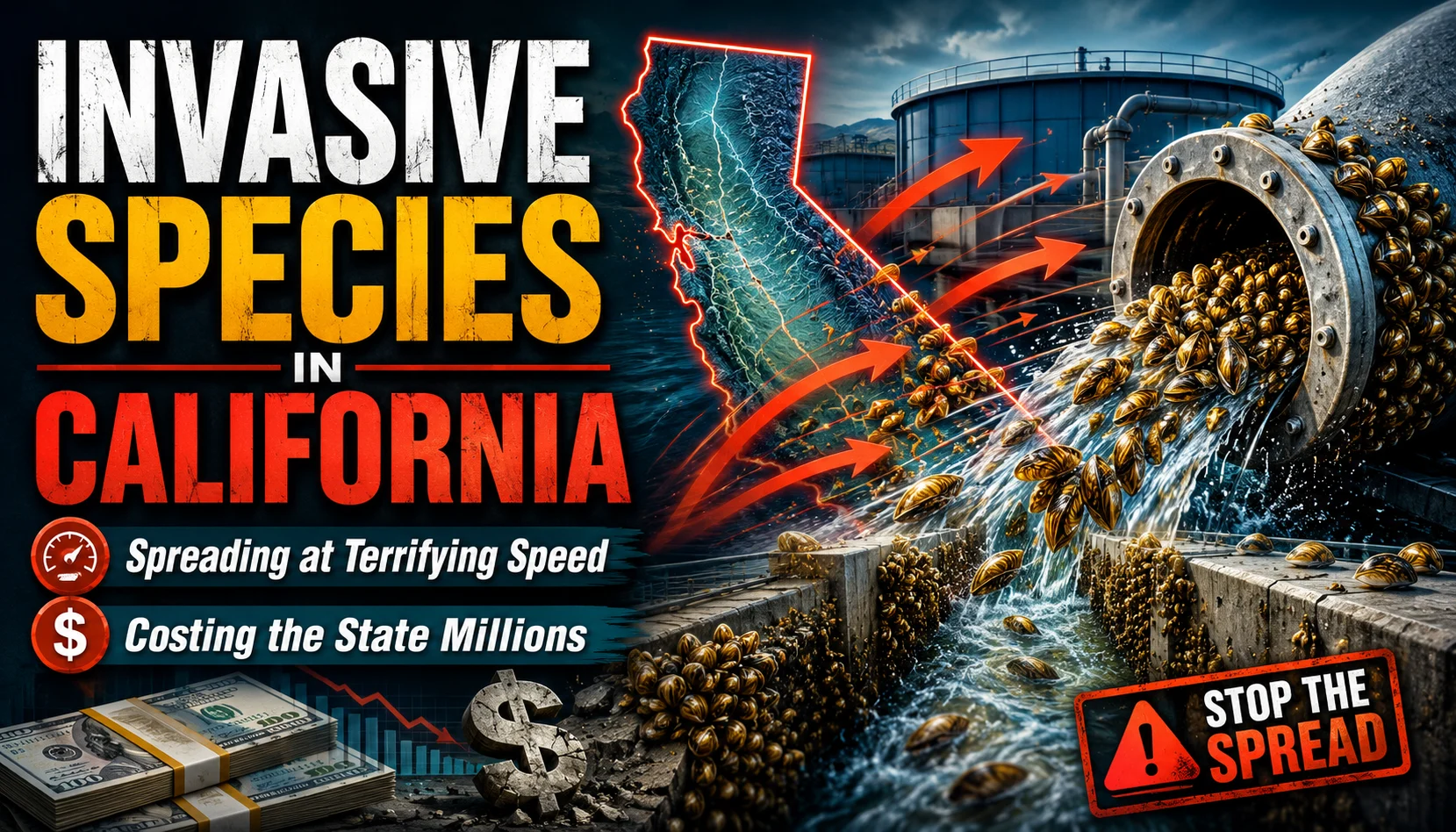
California’s invasive species problem is often described as a nature story. The golden mussel outbreak shows why that framing is too soft. This is a plumbing, farming, boating, and budget story. Since the first confirmed North American detection in California in October 2024, the small bivalve has moved through the Sacramento-San Joaquin Delta and connected water systems, forcing agencies to shift from simple prevention messaging toward containment, treatment, and infrastructure protection. By May 30, 2026, the issue had triggered local emergency declarations in San Joaquin County and Kern County, with one widely reported treatment campaign costing about $3 million (People). The reader-friendly takeaway is blunt: invasive species get expensive when they stop being “out there” and start living inside the machinery that delivers water.
What changed in California as of May 30, 2026?
The outbreak is no longer just an unusual sighting near the Port of Stockton. California officials first reported golden mussels in the Sacramento-San Joaquin Delta in October 2024, calling it the first known occurrence of the species in North America and warning that it posed an immediate threat to the Delta, state waters, conveyance systems, infrastructure, and water quality (CDFW).
The detection record then became a map of California’s water network. CDFW’s June 2025 timeline lists detections at O’Neill Forebay, the Skinner Fish Facility at the entrance to the California Aqueduct, the Tracy Fish Facility at the entrance to the Delta-Mendota Canal, Bethany Reservoir, Las Perillas Pumping Plant, Dos Amigos Pumping Plant, and other facilities connected to major water delivery systems (CDFW detections timeline). By September 2025, DWR, CDFW, and State Parks had confirmed golden mussels at Pyramid Lake in Los Angeles County and Silverwood Lake in San Bernardino County, described as the southernmost State Water Project reservoirs where the species had been detected at that time (CDFW/DWR).
The government response escalated in 2026. San Joaquin County proclaimed a local emergency on April 28, citing risks to water conveyance, flood control, agriculture, recreation, and the Delta ecosystem (San Joaquin County). Kern County followed on May 12, adopting a resolution proclaiming a state of local emergency because of the presence and threat of invasive golden mussels (Kern County). That is the moment the story changed: California moved from “watch the boat ramps” to “protect the system.”
Why can a mussel become a statewide problem so quickly?
Golden mussels are built for movement. CDFW’s fact sheet says adults can attach to surfaces with byssal threads, spawn multiple times each year, and produce planktonic offspring called veligers (CDFW fact sheet). That matters because adults can hitchhike on hulls and equipment, while larvae can travel in trapped water.
The habitat range is also unusually forgiving. Golden mussels can inhabit fresh and brackish-water lakes, rivers, creeks, wetlands, bays, and canals across a broad temperature range, and CDFW notes they can attach to man-made and natural substrates, soft substrates, and aquatic plants (CDFW fact sheet). The State of California’s response framework adds a California-specific alarm bell: the species can establish in waters with lower calcium levels than zebra or quagga mussels require, putting most California waters at risk (State of California framework).
The phrase “terrifying speed” is dramatic, but it captures the management problem. Once an organism can move through ballast water, recreational vessels, in-water equipment, canals, and aqueducts, the unit of risk is not one lake; it is the whole connected pathway. In April 2026, ODFW staff intercepted golden mussels on a watercraft being transported from the Sacramento River Delta to Oregon, a useful reminder that the pathway does not stop at California’s border (ODFW via CDFW).
Why does the outbreak get expensive before the public notices?
The expensive part is mostly hidden. A beach visitor may never see a golden mussel. A water operator sees them inside screens, pumps, intake structures, small-diameter pipes, fish facilities, cooling-water lines, fire-protection systems, boat motors, and irrigation equipment.
CDFW says golden mussels form dense colonies, consume aquatic microscopic plants and animals that native species and sport fish depend on, impede water flow, clog pipes, foul watercraft motors, and require ongoing removal to maintain operations (CDFW fact sheet). DWR says the State Water Project delivers water to 27 million Californians and 750,000 acres of farmland, which explains why even small operational disruptions can become public costs (DWR).
This is the invasive-species cost curve: cheap to prevent, costly to contain, and potentially permanent to manage. USGS puts the national scale in perspective: invasive species cost the United States more than $120 billion annually, and the U.S. Register of Introduced and Invasive Species contains 14,700 records across Alaska, Hawaii, and the conterminous United States (USGS). For mussels specifically, the Bureau of Reclamation says quagga and zebra mussels alone are responsible for more than $1 billion annually in control and infrastructure costs nationwide, and that golden mussel detections in California have increased the urgency for better decontamination tools (Bureau of Reclamation).
What is California doing now?
California is using three overlapping strategies: prevention, containment, and infrastructure hardening. The state’s Golden Mussel Response Framework sets a goal of preventing further introductions and spread, containing mussels within currently infested waters, and suppressing mussel populations inside infested waters to reduce harm to the environment, economy, infrastructure, and human health (State of California framework).
That sounds tidy on paper. In practice, each layer has a different owner, cost, and clock.
| Response front | What it means | Why it matters now |
|---|---|---|
| Pathways | Inspect, decontaminate, clean, drain, and dry boats and equipment. | A boat or trapped-water pathway can move adults or veligers into a new waterbody (CDFW fact sheet). |
| Pipes | Add monitoring, treatment, ultraviolet systems, chemical controls, hot-water tools, and mechanical removal where appropriate. | DWR has described measures to protect pumping plants, hydroelectric plants, water supply deliveries, and small-diameter piping (CDFW/DWR). |
| Policy | Emergency declarations, grants, shared detection data, and federal innovation challenges. | Local emergencies and Reclamation’s prize challenge show that agencies need money, legal speed, and better tools (San Joaquin County, Bureau of Reclamation). |
The original synthesis is simple: California cannot treat this as one species in one place. It has to manage three fronts at once: pathways, pipes, and policy. Miss one, and the other two get more expensive.
What should boaters, water districts, and residents do next?
For boaters, the rule is boring because it works: clean, drain, and dry. CDFW’s fact sheet identifies ballast water, attached adults on watercraft and equipment, and water held inside equipment as pathways for spread (CDFW fact sheet). Before launching, check the specific reservoir or lake rules; after leaving, remove visible material, drain all water, and let equipment dry before moving to another waterbody.
For water managers, the lesson is to budget for detection and response before the first clog. The Golden Mussel Response Framework treats prevention as preferred, but it also calls for containment and suppression in places where mussels are already present (State of California framework). Waiting for a full shutdown is the expensive version of data collection.
For residents, the job is not to memorize mussel biology. It is to understand why a tiny organism can show up as higher public costs, restricted boating access, emergency board meetings, and new infrastructure spending. The outbreak is a warning that California’s water system is only as resilient as its slowest inspection point.
FAQ
What invasive species is causing California’s latest water-infrastructure concern?
The golden mussel, Limnoperna fortunei, is the focus. California officials first confirmed it in the Sacramento-San Joaquin Delta and O’Neill Forebay in October 2024 (CDFW).
Why are golden mussels costly?
They attach to hard surfaces, form dense colonies, clog pipes and screens, foul motors, and require repeated removal or treatment to keep water systems working (CDFW fact sheet).
Can California eradicate golden mussels?
Eradication from open, connected waterways is unlikely once a population is established, so agencies are emphasizing prevention, containment, suppression, and infrastructure protection (State of California framework).
How can boaters help stop the spread?
Boaters should clean, drain, and dry watercraft and equipment after every outing, follow local inspection rules, and avoid moving water between lakes, canals, and reservoirs (CDFW fact sheet).
Is the problem only about recreation?
No. Boating is one pathway, but the larger risk is to water delivery, agriculture, flood control, hydropower facilities, ecosystems, and public costs (San Joaquin County).
Sources
- Golden Mussel Fact Sheet — California Department of Fish and Wildlife, 2025-05-28. Used for biology, habitat suitability, pathways, and impacts.
- Invasive Non-Native Golden Mussel Discovered in the Sacramento–San Joaquin Delta — California Department of Fish and Wildlife, 2024-10-31. Used for the initial detection and immediate-threat framing.
- Golden Mussel Detections in California, October 2024-June 2025 — California Department of Fish and Wildlife, 2025-06-30. Used for the detection timeline across water facilities.
- Invasive Golden Mussel Detected at Silverwood Lake and Pyramid Lake — California Department of Fish and Wildlife / California Department of Water Resources, 2025-09-15. Used for State Water Project reservoir detections and prevention status.
- State Agencies Highlight New Measures to Combat Golden Mussels Following Detection at San Luis Reservoir — California Department of Fish and Wildlife / California Department of Water Resources, 2025-10-03. Used for infrastructure-protection measures.
- Golden Mussel Response Framework — State of California, 2025-04-14. Used for response goals, risk framing, and coordination strategy.
- One Year Later How California is Combating Golden Mussels — California Department of Water Resources, 2025-10-24. Used for State Water Project scale and mitigation context.
- San Joaquin County Board of Supervisors Proclaims Local Emergency Over Invasive Golden Mussel Threat — San Joaquin County, 2026-04-28. Used for local emergency details and listed risks.
- Board of Supervisors Meeting Recap for May 12, 2026 — Kern County, 2026-05-12. Used for Kern County’s local emergency action.
- Invasive golden mussels intercepted on incoming watercraft at Ashland inspection station — Oregon Department of Fish and Wildlife via California Department of Fish and Wildlife, 2026-04-09. Used for interstate pathway evidence.
- Reclamation Launches Prize Challenge to Address Aquatic Invasive Species in Watercraft Ballast Systems — U.S. Bureau of Reclamation, 2026-02-26. Used for federal decontamination challenge and mussel-cost context.
- United States Register of Introduced and Invasive Species — U.S. Geological Survey, 2025-03-18. Used for national invasive-species cost and records context.
- Invasive Species in California Can Spread with 'Terrifying Speed' and Is Costing the State Millions — People, 2026-05-29. Used for the reported “terrifying speed” framing and reported local treatment cost.