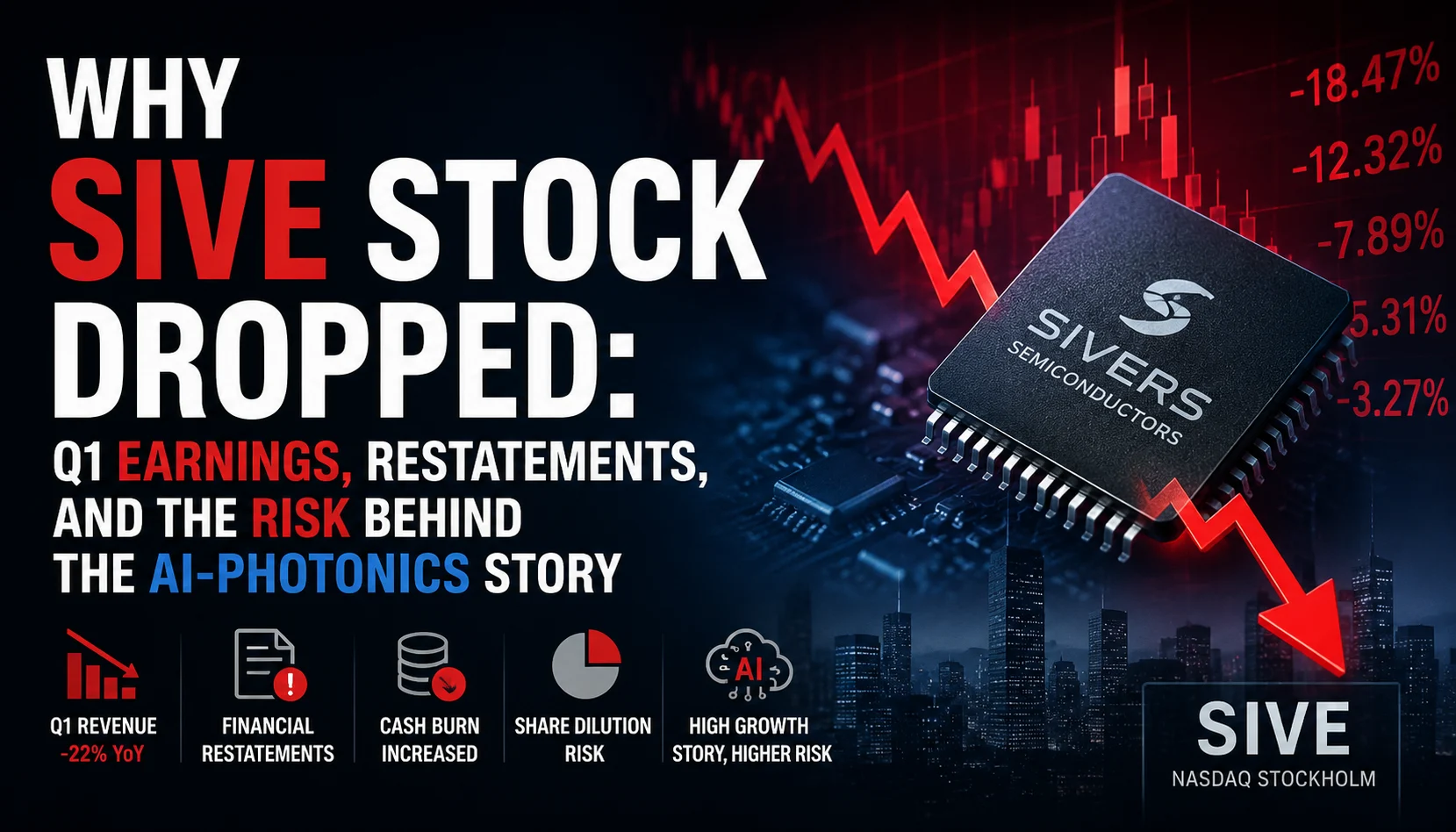
Why SIVE Stock Dropped: Q1 Earnings, Restatements, and the Risk Behind the AI-Photonics Story
The simplest explanation: SIVE stock weakened because a huge market rally ran into a messy reality check — lower Q1 revenue, heavier cash burn, restated financials, financing dilution, and a growth story that still depends on future customer ramps.
This article is a general market analysis based on public sources available as of May 29, 2026. It is not investment advice.
Quick answer: what caused the SIVE stock decline?
SIVE is the Nasdaq Stockholm ticker for Sivers Semiconductors AB, a Swedish semiconductor company focused on photonics and wireless technologies for AI data centers, SATCOM, defense, telecom, LiDAR, and fixed wireless access.
The recent stock weakness looks like a combination of six forces:
- Q1 2026 revenue fell 22% year over year to SEK 61.9 million.
- Adjusted EBITDA worsened to SEK -13.8 million from SEK -6.0 million a year earlier.
- Operating cash flow was negative SEK -49.2 million, while available cash at March 31 was SEK 26.6 million.
- The 2025 Annual Report included restatements, including a worse 2025 EBIT and net result than previously reported.
- The company raised capital through a directed share issue, strengthening liquidity but adding dilution.
- The stock had already surged dramatically, making it vulnerable to profit-taking when the earnings print did not fully match the market’s excitement.
That does not mean the Sivers growth story is dead. It means the stock started trading like a company that must now prove its pipeline can turn into revenue, not just attention.
The stock move: this was not an ordinary pullback
SIVE has been one of the more dramatic small-cap semiconductor stories in Europe. TradingView showed SIVE up about 132% over the prior month and roughly 1.65K% over the prior year, while also flagging high volatility. Investing.com’s live quote page for the Stockholm-listed instrument showed wide intraday trading on May 29, with a range from SEK 59.25 to SEK 74.90 and a 52-week range from SEK 2.85 to SEK 90.50.
That matters because the cause of a decline is different after a 10% rally than after a multi-hundred-percent or multi-thousand-percent run. In SIVE’s case, the market had been pricing in a lot: AI data center exposure, photonics demand, SATCOM growth, defense programs, and a possible U.S. dual listing.
When a stock is priced for acceleration, a merely “timing-related” earnings miss can still hurt.
Q1 2026 earnings: the headline numbers were weak
Sivers’ Q1 2026 report showed a clear year-over-year revenue decline and weaker operating profitability.
| Metric | Q1 2026 | Q1 2025 | Read-through |
|---|---|---|---|
| Net sales | SEK 61.9m | SEK 78.9m | Down 22% YoY |
| Adjusted EBITDA | SEK -13.8m | SEK -6.0m | Loss widened |
| EBITDA | SEK -24.7m | SEK -8.6m | Loss widened |
| EBIT | SEK -41.5m | SEK -28.3m | Operating loss widened |
| Net result | SEK -42.7m | SEK -49.9m | Net loss improved, helped by financial items |
| Operating cash flow | SEK -49.2m | SEK -15.8m | Cash burn increased |
| EPS | SEK -0.14 | SEK -0.19 | EPS loss narrowed |
The official report said the revenue decline came from FX headwinds and revenue timing related to delays in defense spending approval. Wireless sales fell 16% year over year, while Photonics sales fell 32%.
There was also a market-expectation problem. TradingView displayed last-quarter EPS of SEK -0.14 versus an estimate of SEK -0.10 and revenue of roughly SEK 62.07 million versus an estimate of SEK 74.00 million. Estimate providers vary, but the direction is clear: the quarter landed below what at least some market data platforms were showing as expected.
Management’s explanation: timing, FX, and investment
Management’s message was not “demand is broken.” It was “revenue moved.”
In the CEO statement, Sivers said the U.S. government shutdown and related defense budget approvals delayed some expected revenue from Q1 and Q2 into the second half of 2026. The company also said expenses rose because it expanded sales headcount to support the pipeline and prepared for a possible U.S. dual listing.
That explanation is plausible, but the market usually discounts “timing” explanations when three things are happening at once: revenue is down, cash flow is negative, and the share price has already run hard. Investors do not only ask whether revenue is delayed. They ask whether the next quarter will prove it.
The accounting overhang: restatements changed the tone
The most uncomfortable part of the story is not just Q1. It is the accounting clean-up around the 2025 Annual Report.
On May 13, Sivers said it had upgraded its consolidated financial statements for 2024 and 2025 to better align with U.S. PCAOB standards as part of evaluating a possible Nasdaq New York dual listing. The company said adjustments included revenue reallocation between periods and to 2026 or later, revised inventory valuations, updated fair-value assumptions for share-based compensation, and impairment of capitalized development expenditures.
The numbers changed meaningfully. Sivers revised 2025 EBIT to SEK -177.8 million from SEK -141.3 million, revised the 2025 net result to SEK -222.6 million from SEK -186.5 million, and changed EPS to SEK -0.81 from SEK -0.69.
That does not automatically mean something is fundamentally wrong. PCAOB alignment can be part of preparing for U.S. capital markets. But to equity investors, restatements usually add a risk premium. They make the market ask: “What else might move?”
Financing and dilution: necessary, but not free
Sivers also raised capital. On April 15, the company announced a directed share issue of 8.62 million ordinary shares at SEK 14.5 per share, amounting to approximately SEK 125 million before transaction costs. The company said the issue would result in dilution of approximately 2.5% on a fully diluted basis.
The capital raise strengthens liquidity, and the company framed it as funding for pipeline growth, product expansion, organizational readiness, and balance-sheet flexibility. That is the positive side.
The market’s more skeptical read is different: if a company reports negative operating cash flow of SEK -49.2 million in Q1 and had SEK 26.6 million of available cash at quarter-end, the new capital is not just optional growth fuel. It is also part of the runway story.
The bull case is still alive — but it is now more testable
Sivers is not a no-news story. The company has several pieces of positive news that explain why investors were interested in the first place.
In Q1, the company said its opportunity pipeline grew 77% year-to-date to $799 million. After the quarter, Sivers announced a collaboration with Jabil on a 1.6T linear receive optical transceiver module using Sivers’ DFB lasers. It also announced a $1.5 million development partnership with Tachyon Networks for a 60 GHz mmWave transceiver for fixed wireless access, and a $6.6 million Year 2 EW STAR award through the Microelectronics Commons/NEMC program.
These are not trivial headlines. They point to real customer engagement in AI optical interconnects, fixed wireless access, and defense electronics.
The catch is that markets do not value a pipeline the same way forever. At first, a pipeline can re-rate a stock. Later, the same pipeline must convert into purchase orders, product shipments, gross margin, and cash generation.
The dual-listing angle cuts both ways
The possible Nasdaq New York dual listing is one of the most important catalysts in the story. Sivers said on April 16 that it was evaluating a dual listing while remaining domiciled in Sweden, with the goal of improving access to U.S. tech-focused capital markets and broadening the investor base.
That can support a higher valuation if U.S. investors give Sivers more credit for AI, photonics, and defense exposure. But the preparation process also created accounting work, report delays, restatements, and higher operating costs.
So the dual-listing story is not purely bullish or bearish. It is a catalyst with execution risk.
What investors should watch next
The next phase is simple to describe and hard to execute: Sivers has to turn “2027 ramp” language into numbers.
The key items to watch are:
- Q2/H1 2026 report on August 6, 2026, according to the company’s financial calendar.
- Whether delayed defense-related revenue appears in the second half of 2026.
- Cash balance and operating cash flow after the SEK 125 million share issue.
- Order announcements tied to LiDAR, AI data center lasers, SATCOM, and FWA.
- Progress on the potential Nasdaq New York dual listing.
- Whether the $799 million pipeline becomes booked revenue, not just a slide-deck number.
Bottom line
SIVE stock did not fall because the story disappeared. It fell because the story became more demanding.
The company still has exposure to attractive markets: AI data centers, photonics, SATCOM, defense, LiDAR, and fixed wireless access. But Q1 2026 showed lower revenue, weaker adjusted EBITDA, heavy operating cash outflow, and a need for fresh capital. The annual-report restatements added an accounting overhang just as investors were already debating whether the stock had moved too far, too fast.
The cleanest way to frame SIVE now is this: the upside story is about 2026-2027 conversion; the downside risk is that the market has already paid for that conversion before it has fully appeared in the income statement.
FAQ
Why did SIVE stock decline?
The decline appears tied to a mix of weaker Q1 2026 revenue, wider adjusted EBITDA losses, negative operating cash flow, accounting restatements, dilution from a directed share issue, and profit-taking after an extraordinary share-price rally.
Did Sivers Semiconductors miss earnings?
Officially, Sivers reported Q1 2026 net sales of SEK 61.9 million, down 22% year over year, and adjusted EBITDA of SEK -13.8 million. TradingView displayed revenue and EPS below its estimates, although estimate sources can vary.
Is SIVE stock a buy after the drop?
That depends on risk tolerance and whether an investor believes Sivers can convert its pipeline into profitable revenue. The stock has major growth exposure, but it also carries execution, cash-flow, dilution, valuation, and accounting-transition risks.
What is the biggest positive catalyst for SIVE?
The biggest positive catalyst would be evidence that delayed revenue is converting in the second half of 2026 and that 2027 customer ramps in AI data centers, LiDAR, SATCOM, defense, and FWA are becoming real purchase orders and shipments.
What is the biggest risk?
The biggest risk is that the market has capitalized future growth too aggressively before Sivers has proved sustained revenue growth, positive cash flow, and scalable profitability.
Sources
- Sivers Semiconductors Interim Report Q1 2026 — company report, May 29, 2026. Used for Q1 financials, management commentary, cash flow, and outlook.
- Sivers Semiconductors Q1 2026 press-release summary on Inderes — May 29, 2026. Used for Q1 release summary and management quote.
- Sivers 2025 Annual Report restatement press release — company press release, May 13, 2026. Used for restated 2025 financials and PCAOB/uplisting context.
- Sivers directed share issue announcement — company press release, April 15/16, 2026. Used for SEK 125 million financing and dilution details.
- Sivers potential Nasdaq New York dual listing announcement — company press release, April 16, 2026. Used for dual-listing rationale and PCAOB audit-uplift context.
- Sivers and Jabil collaboration announcement — company press release, April 15, 2026. Used for AI data-center photonics catalyst.
- Sivers and Tachyon Networks $1.5M partnership announcement — company press release, May 6, 2026. Used for fixed wireless access catalyst.
- Microelectronics Commons / Nasdaq release on Sivers Year 2 EW STAR funding — May 19, 2026. Used for $6.6 million defense program extension.
- Sivers financial calendar — company investor page. Used for upcoming reporting dates.
- TradingView SIVE stock page — market data page accessed May 29, 2026. Used for share-performance and estimate context.
- Investing.com SIVE/SIVEH quote page — market data page accessed May 29, 2026. Used for intraday quote range and valuation context.