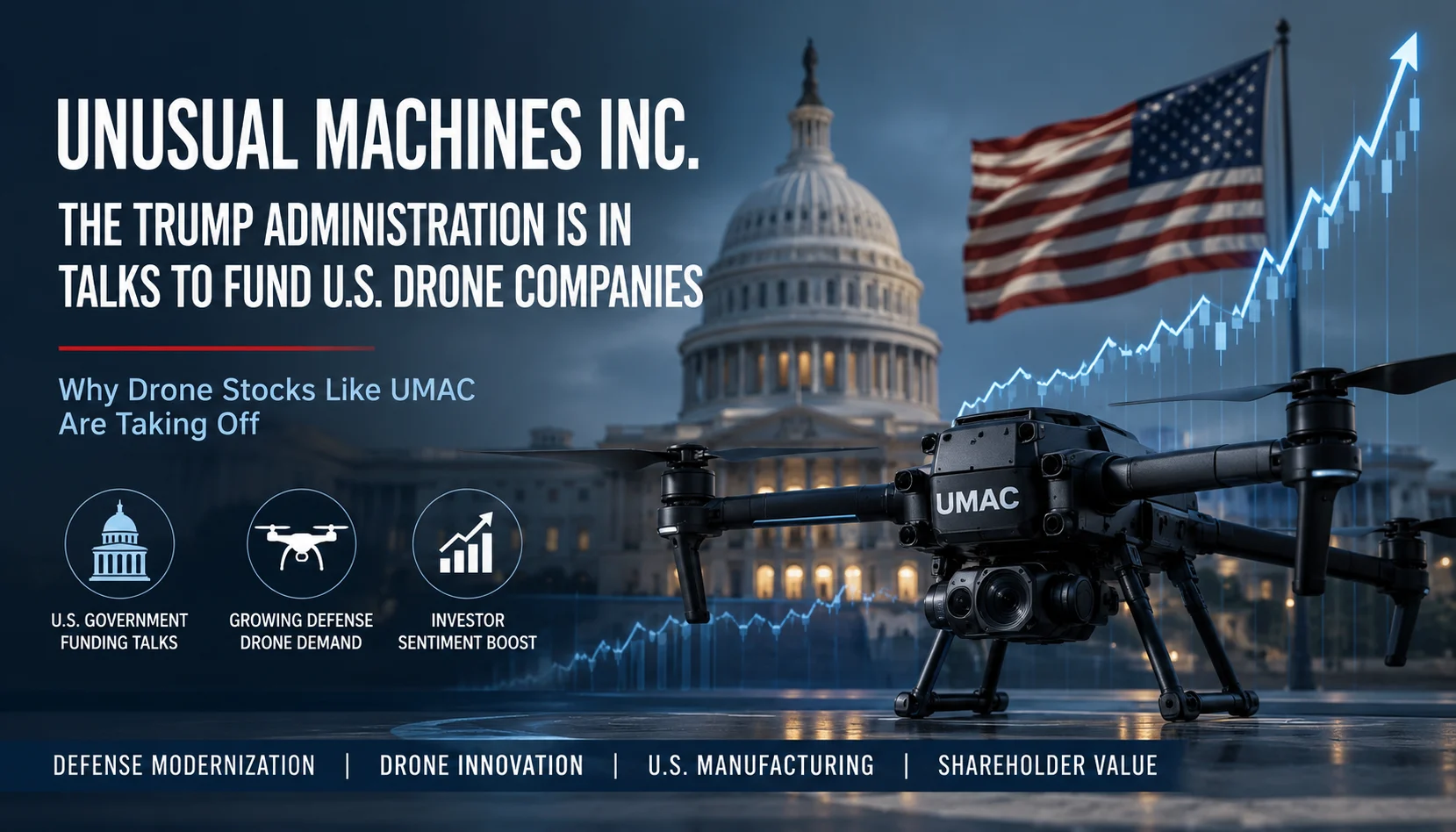
Why Unusual Machines and Drone Stocks Jumped: The Pentagon Funding Story Behind UMAC’s Rally
Unusual Machines did not rally because a new funding deal was confirmed. It rallied because investors suddenly priced in the possibility that Washington may become a direct financier of U.S.-made drone manufacturing.
The cleanest way to read the latest move in Unusual Machines Inc. (NYSE American: UMAC) is this: the market is treating domestic drone supply chains like the next policy-backed defense trade.
On May 28, 2026, Reuters reported that the Trump administration was in talks to provide funding to U.S. drone companies, including Unusual Machines and Sequoia-backed Neros, citing a Wall Street Journal report based on people familiar with the matter. Reuters also noted that the discussions involved the Pentagon and the Office of Strategic Capital, and that some proposals under discussion could include debt and equity funding that may give the government ownership stakes. [Reuters]
That is the headline. The real story is bigger: drones have moved from “interesting defense tech” to a budget, supply-chain, and geopolitical priority. UMAC sits in the middle of that narrative because it sells drone components rather than betting on only one drone platform.
This article is general market research, not personal investment advice.
The reason UMAC rose: a policy headline met a stock already wired for the drone narrative
The reported funding talks gave investors a simple story to buy:
| Layer | What changed | Why it matters for UMAC |
|---|---|---|
| Immediate catalyst | The Wall Street Journal reported that the Trump administration is discussing funding agreements with U.S. drone companies. | UMAC was named as one of the companies tied to the talks, making it a direct headline beneficiary. |
| Policy backdrop | Drone dominance has become part of the administration’s defense and industrial-base agenda. | Investors see U.S.-made drone components as a strategically supported supply chain. |
| Company positioning | UMAC describes itself as a provider of NDAA-compliant drone components. | Components can benefit from multiple drone programs, not just one airframe winner. |
| Market psychology | Small-cap defense-tech names can move violently when a government-financing story appears. | The stock moved like an option on future procurement and financing, not like a mature earnings story. |
Barron’s reported that UMAC surged sharply after the funding report and said other drone-related names, including Ondas, Red Cat, and AeroVironment, also rallied on the same day. [Barron’s] Investor’s Business Daily similarly described a broad drone-stock move, citing gains in UMAC, Red Cat, AeroVironment, Kratos, and Ondas after the funding report. [Investor’s Business Daily]
The point is not just that UMAC was up. The point is that the whole drone basket moved because the report suggested a possible new financing channel for the sector.
What the reported funding talks actually mean
The reported discussions are not the same as a signed contract, grant, or loan. That distinction matters.
According to Reuters, the talks include the Pentagon and the Office of Strategic Capital, a lending unit focused on companies important to national-security supply chains. The report said proposals being discussed could involve debt and equity, potentially giving the government ownership stakes. Reuters also said it could not immediately verify the Wall Street Journal report and that the White House, Pentagon, and companies did not immediately respond to requests for comment. [Reuters]
So the market is not reacting to certainty. It is reacting to a possibility with unusually strong signaling value.
For a drone manufacturer or component supplier, government-backed financing can matter in three ways:
- It can help companies expand production before purchase orders arrive.
- It can validate a company as strategically relevant to the defense supply chain.
- It can lower the cost of scaling domestic manufacturing, especially when parts, batteries, motors, cameras, and flight controllers must be made or sourced in the United States.
But the structure matters. A loan is different from an equity stake. A conditional loan is different from a grant. Government equity could help a company scale, but it could also dilute existing shareholders depending on the terms.
That is why the next important question is not simply “Does UMAC get funding?” It is “What are the terms, and does the funding convert into durable orders?”
Why Washington is suddenly more interested in drones
The Trump administration’s drone push did not begin with the May 2026 funding report.
In June 2025, the White House issued the executive order “Unleashing American Drone Dominance,” which called for scaling domestic drone production, expanding exports of trusted American-made drone technologies, and reducing reliance on foreign sources. [White House] The Federal Register version of the order states that agencies should prioritize the integration of UAS manufactured in the United States over foreign-made systems to the maximum extent permitted by law. [Federal Register]
That policy language is important for investors because it turns domestic drone manufacturing into more than a product category. It becomes a strategic supply-chain category.
The budget side points in the same direction. Reuters reported in April 2026 that the Pentagon’s fiscal 2027 defense request includes a “presidential priorities” category covering Golden Dome missile defense, drone dominance, artificial intelligence and data infrastructure, and the defense industrial base. The same report said senior officials described the request as the largest U.S. investment in drone warfare and counter-drone technology, with $53.6 billion for autonomous drone platforms and warzone logistics, and $21 billion for munitions, counter-drone technologies, and advanced systems. [Reuters]
The Pentagon’s own budget messaging also emphasizes drone dominance, supply-chain strength, and small and medium-sized defense suppliers. Its April 2026 budget article says the FY2027 request aims to “supercharge” the defense industrial base and includes investments in drone dominance and space superiority. [Pentagon / Department of War]
That combination explains the market’s reaction. Investors are not only buying today’s revenue. They are buying the possibility that U.S. drone supply chains may receive procurement, lending, regulatory, and political support at the same time.
Why the Office of Strategic Capital matters
The Office of Strategic Capital is worth watching because it is not a normal procurement office. It is designed to bring capital into national-security supply chains.
The office says it develops strategies and partnerships to accelerate private investment in critical supply-chain technologies needed for national security. Its public page says direct loans are available up to $150 million to finance projects in the United States. [Office of Strategic Capital]
A 2024 Federal Register notice said OSC was making up to $984 million available in direct loans for equipment financing in covered technology categories, with loans generally in the $10 million to $150 million range. [Federal Register]
That gives the reported drone talks a more concrete mechanism. The government does not have to buy every drone immediately to support the industry. It can help finance manufacturing capacity, equipment, production lines, and supply-chain expansion.
For UMAC, that is the part investors care about. The company’s story is not only “we sell drones.” It is “we can be a domestic parts layer for many drone builders.” If Washington wants more U.S.-made drones, parts suppliers may become chokepoint assets.
UMAC’s fundamental case: fast growth, strong cash, but not a simple profitability story
UMAC’s recent financials give the rally some substance, but also a warning label.
In its May 14, 2026 shareholder letter filed with the SEC, Unusual Machines reported first-quarter revenue of about $8.1 million, up 296% year over year and 65% quarter over quarter. The company also reported roughly $222.9 million in cash at March 31, 2026, compared with $103.2 million at the end of 2025. [SEC filing]
That is the bullish side: revenue is scaling quickly, and the balance sheet is unusually liquid for a small defense-tech manufacturer.
The caution is in the same filing. UMAC reported a GAAP operating loss of about $7.3 million in Q1 2026. Its GAAP net income of about $10.3 million was primarily helped by unrealized and realized gains from short-term investments, plus interest income. The company itself disclosed $9.5 million in unrealized gains and $7.3 million in realized investment gains during the quarter. [SEC filing]
In plain English: UMAC is growing fast, but the core manufacturing operation is still in scale-up mode. The stock market may care more about future demand than current operating profit, but investors should not confuse a policy catalyst with a finished business model.
The Army order gave UMAC credibility before the funding headline
UMAC was not a random ticker pulled into the drone trade overnight.
In a 2025 Form 10-Q, the company disclosed that it secured an order from the U.S. Army’s 101st Airborne Division for 3,500 NDAA-compliant motors made at its U.S.-based facility. The motors support the Attritable Battlefield Enabler V1.01 drones. The company also said the Army indicated plans to target an additional order of 20,000 components, including motors, in 2026. [SEC filing]
The same filing disclosed an $800,000 purchase order from Red Cat and a $12.8 million purchase order connected to Strategic Logix’s Rapid Reconfigurable Systems Line. It also warned that the Strategic Logix purchase order had no formal contract backstopping it and that UMAC remained dependent on fulfilling backlog for a small number of customers. [SEC filing]
That is the tension in the stock: UMAC has real demand signals, but the company is still small enough that a few programs, customers, or procurement changes can matter a lot.
The Trump Jr. factor: catalyst, visibility, and risk
Donald Trump Jr. is part of the reason the stock draws attention.
Unusual Machines announced in a November 2024 SEC-filed press release that Donald Trump Jr., described as an investor in the company, had joined its advisory board. [SEC filing] Reuters also noted his advisory role in its May 2026 report on the funding talks. [Reuters]
For the market, that connection can amplify visibility. For risk analysis, it cuts both ways.
On one hand, investors may believe politically connected defense-tech companies have better access to the policy conversation. On the other hand, that exact perception can create scrutiny. In January 2026, Senators Elizabeth Warren, Richard Blumenthal, and Andy Kim publicly raised concerns about possible conflicts of interest involving Department of Defense contracts and loans to companies associated with Donald Trump Jr. [Senator Warren press release]
This does not prove wrongdoing by UMAC. It does mean that political headline risk is part of the stock’s risk profile. The same factor that brings attention can also bring hearings, letters, delays, or tighter disclosure demands.
Why other drone stocks moved too
UMAC was the most direct public-market name in the report, but the rally spread because the story was sector-wide.
A funding program for U.S. drone manufacturing does not benefit only one company. It can lift sentiment across several categories:
- Drone platforms and systems: companies building complete drones, ISR platforms, tactical systems, or autonomous aircraft.
- Counter-drone and defense electronics: companies tied to detection, interception, sensors, and battlefield networks.
- Component suppliers: companies producing motors, cameras, batteries, controllers, goggles, radios, and other parts that make drone scaling possible.
- Defense primes and mid-cap suppliers: larger companies with unmanned systems exposure, though they may move less dramatically because drones are only part of their revenue mix.
That is why names such as Red Cat, AeroVironment, Kratos, Ondas, AIRO, AgEagle, and other drone-related stocks can move on the same headline even when they are not all named as funding targets.
The market is effectively asking: “Who sells the picks and shovels for a domestic drone buildout?” UMAC’s appeal is that it can be framed as a picks-and-shovels supplier.
The part investors should not miss
The strongest bullish argument for UMAC is not that it is guaranteed to win a government financing deal. No public source confirms that.
The stronger argument is structural: the United States is trying to close a drone-production gap, reduce reliance on foreign components, and move faster on low-cost unmanned systems. If that shift continues, the companies that can supply compliant domestic components may matter more than their current revenue base suggests.
The bear case is just as straightforward: the stock has already priced in a lot of possibility. If no formal funding announcement arrives, if the terms are dilutive, if procurement favors other companies, or if UMAC’s operations lag its expansion plan, the same narrative that pushed the stock higher can reverse quickly.
The market is not waiting for perfect proof. It is repricing a policy option.
What to watch next
The next useful checkpoints are concrete, not promotional:
- A formal Pentagon or OSC announcement. Reported talks are not enough. Watch whether UMAC is named, the funding size, and the instrument used.
- Loan versus equity terms. Loans, guarantees, and equity stakes have very different implications for shareholders.
- Follow-on purchase orders. Financing can build capacity, but orders prove demand.
- Q2 2026 margins and cash use. UMAC is expanding rapidly. The key question is whether revenue absorbs that capacity.
- Customer concentration. A small number of large programs can accelerate growth, but they can also create lumpiness.
- Political scrutiny. Any Trump-family-linked defense funding may draw additional oversight.
Bottom line
UMAC’s rally is best understood as a convergence trade: government funding speculation, domestic drone policy, defense-budget expansion, and a company already positioned around NDAA-compliant U.S. drone components.
That does not make the stock safe. It makes it sensitive.
If the funding report turns into a signed, well-structured deal plus real orders, the market may treat UMAC as a strategic supplier in a fast-growing domestic drone ecosystem. If the headline fades or the terms disappoint, the rally could look more like a speculative spike than a re-rating.
For now, the right framing is simple: Unusual Machines is not just trading on drones. It is trading on the possibility that Washington wants to fund the factory behind the drones.
FAQ
Why did Unusual Machines stock rise recently?
Unusual Machines rose after reports that the Trump administration was discussing funding agreements with U.S. drone companies, including UMAC. The stock reacted because investors viewed the report as a possible signal of government-backed financing for domestic drone manufacturing, not because a final deal was confirmed.
Has UMAC received confirmed new funding from the Pentagon?
No public source reviewed for this article confirms a finalized new Pentagon funding deal for UMAC as of May 28, 2026. Reuters reported that the discussions were based on a Wall Street Journal report and that Reuters could not immediately verify it independently.
Why are drone stocks rising together?
Drone stocks are rising together because investors are treating U.S.-made drones, counter-drone systems, and drone components as a policy-backed defense theme. If the government finances domestic production, the benefit could spread across platforms, parts, sensors, software, and defense suppliers.
Is UMAC profitable?
UMAC reported GAAP net income of about $10.3 million in Q1 2026, but its SEC-filed shareholder letter shows that much of the gain came from short-term investment gains and interest income. The company also reported a GAAP operating loss of about $7.3 million, so the core operating story is still a scale-up story.
What is the biggest risk in the UMAC rally?
The biggest risk is that the stock is pricing in future government support before final terms are known. Other risks include dilution, execution problems, procurement delays, customer concentration, political scrutiny, and the possibility that funding benefits competitors more directly.
Sources
- Trump administration in talks to fund US drone companies, WSJ reports — Reuters, May 28, 2026. Used for: reported funding talks, named companies, premarket move, funding structures, verification caveat.
- The Trump Administration Is in Talks to Fund U.S. Drone Companies — The Wall Street Journal, May 28, 2026. Used for: original report on funding discussions.
- This Trump-Linked Drone Maker May Get a Pentagon Deal. The Stock Soars 52%. — Barron’s, May 28, 2026. Used for: UMAC and peer stock-market reaction.
- Drone Stocks Jump As Trump Administration Pursues Funding Deals — Investor’s Business Daily, May 28, 2026. Used for: sector-wide drone-stock reaction.
- Unusual Machines First Quarter 2026 Shareholder Letter — SEC filing, May 14, 2026. Used for: Q1 revenue, cash, margin, operating loss, net income, investment gains, expansion commentary.
- Unusual Machines Form 10-Q for quarter ended September 30, 2025 — SEC filing. Used for: Army order, Red Cat purchase order, Strategic Logix purchase order, backlog/customer-concentration risk.
- Donald Trump Jr. Joins Unusual Machines as an Advisor — SEC-filed press release, November 27, 2024. Used for: Trump Jr. advisory role and investor description.
- Unleashing American Drone Dominance — White House executive order, June 6, 2025. Used for: policy push to scale domestic drone production and reduce foreign reliance.
- Unleashing American Drone Dominance — Federal Register, June 11, 2025. Used for: official text on U.S.-manufactured UAS prioritization.
- Office of Strategic Capital — Pentagon / OSC page. Used for: OSC mission and direct-loan information.
- Notice of Funding Availability: Covered Technology Categories Equipment Financing — Federal Register, September 27, 2024. Used for: OSC direct-loan mechanism and funding range.
- $1.5 Trillion Budget Request Prioritizes Service Members, Modernization — Pentagon / Department of War, April 21, 2026. Used for: official defense-budget framing around drone dominance and industrial-base investment.
- Trump’s $1.5 trillion defense budget includes $750 billion for ships, jets and Golden Dome — Reuters, April 21, 2026. Used for: drone-warfare and counter-drone budget figures.
- Warren, Blumenthal, Kim Sound Alarm on Potential for Donald Trump Jr.-Linked Companies to Profit Off Department of Defense Contract Awards, Loans — U.S. Senator Elizabeth Warren press release, January 23, 2026. Used for: political and ethics scrutiny context.