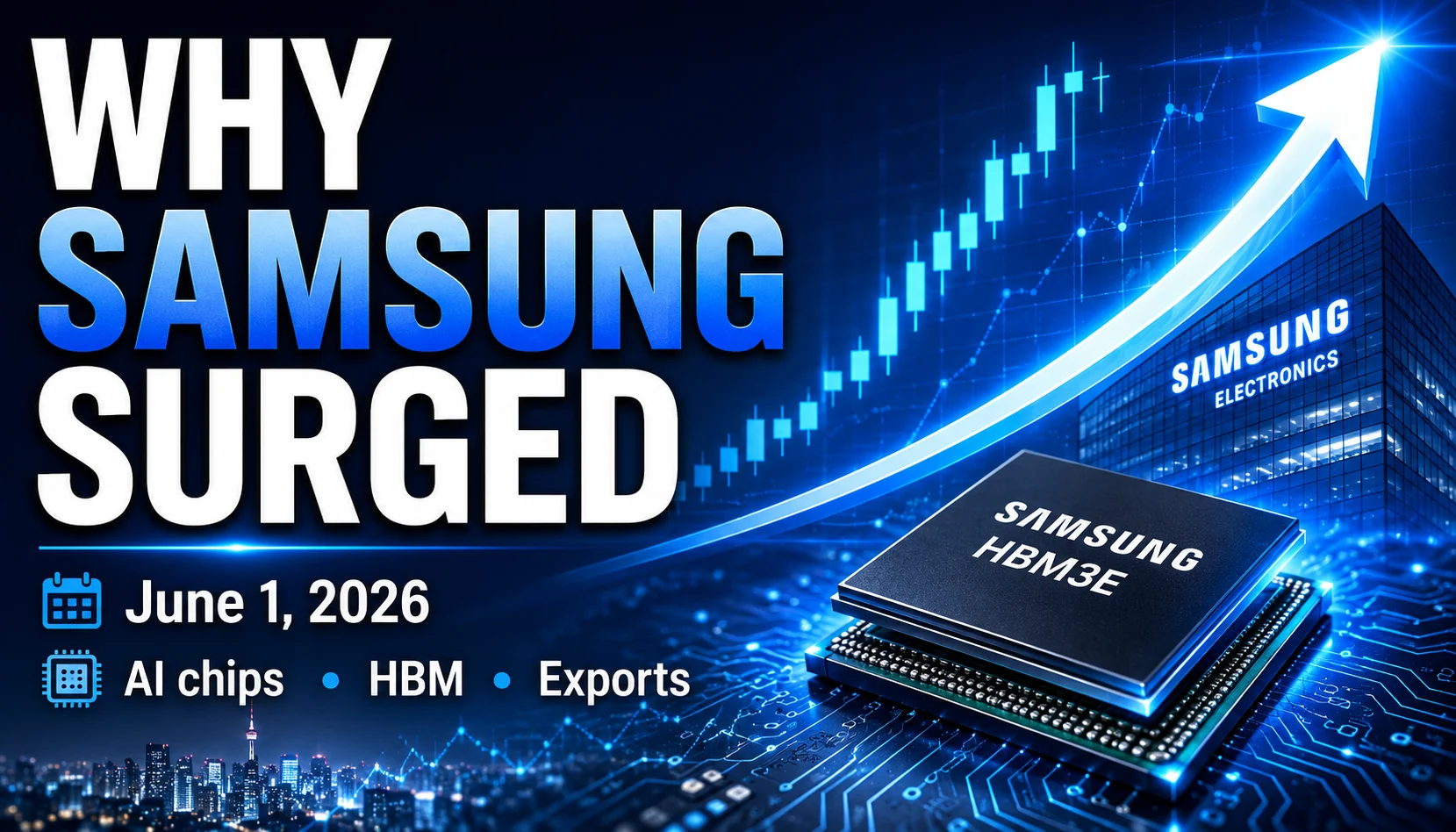
Why Samsung Electronics Surged on June 1, 2026
 Jay Jung
Samsung Electronics jumped on June 1, 2026 because the market suddenly had three signals pointing in the same direction: Nvidia-related AI partnership hopes, fresh HBM4E proof, and record Korean chip-export data.
Key takeaways
- Samsung Electronics rose 9.5% on June 1, lifting its market value above 2,000 trillion won, according to Reuters. Reuters
- The rally was not just “Nvidia hype”; it was a three-part repricing of Samsung’s AI-memory story: customer optionality, HBM technology credibility, and macro demand proof.
- Samsung’s May 29 HBM4E announcement gave investors a concrete product trigger: 12-layer samples, up to 16Gbps speed, and up to 3.6TB/s bandwidth per stack. Samsung Global Newsroom
- South Korea’s May exports, released June 1, showed semiconductor exports up 169.4% year over year to USD 37.16 billion, reinforcing the idea that AI memory demand was not theoretical. The Asia Business Daily
- The risk is that expectations may have moved faster than confirmed orders; the sources reviewed did not show a newly announced Nvidia HBM4E supply contract.
Samsung Electronics’ June 1, 2026 surge was the kind of move that looks mysterious only if you treat it as a one-day headline. The better read is that investors connected three separate dots at once. First, Reuters reported that expected meetings between Nvidia CEO Jensen Huang and Korean executives lifted hopes for AI and robotics tie-ups. Second, Samsung had just said it began shipping samples of its latest HBM4E memory, the kind of product investors watch closely because AI accelerators need high-bandwidth memory. Third, South Korea’s export data showed a chip cycle running hot, with semiconductors doing the heavy lifting. This article breaks down the move without pretending that one meeting, one product sample, or one data point can explain the whole valuation reset.
This is market commentary for general information only, not investment advice.
Why did Samsung Electronics jump on June 1, 2026?
The immediate answer is that Samsung Electronics became the day’s cleanest large-cap proxy for the AI hardware trade in Korea. Reuters reported that Samsung Electronics shares jumped 9.5% on Monday, June 1, 2026, lifting its market value above 2,000 trillion won. Reuters
But the move was bigger than a routine chip-stock bounce. The market was reacting to a convergence trade: Nvidia-related headlines made investors look at Korea; Samsung’s HBM4E update gave them a Samsung-specific reason to buy; and Korea’s export numbers suggested that AI demand was already showing up in national trade data.
A useful way to read the surge is the “three-signal stack”:
| Signal | What investors saw | Why it mattered for Samsung |
|---|---|---|
| Nvidia optionality | Expected Jensen Huang meetings with Korean executives and Nvidia’s Korea-focused AI ecosystem plans | Raised expectations for AI, robotics, memory and foundry collaboration |
| HBM credibility | Samsung began shipping 12-layer HBM4E samples to major global customers | Suggested Samsung may be closing the perceived HBM gap with SK Hynix |
| Export-cycle proof | May semiconductor exports hit USD 37.16 billion, up 169.4% year over year | Confirmed that AI memory demand was visible in hard trade data, not just stock-market narratives |
That stack matters because Samsung had not merely been valued as a memory upcycle stock. It had also been valued through a penalty: the belief that it was behind SK Hynix in high-bandwidth memory, or HBM, for AI accelerators. Reuters quoted a BNK Investment & Securities analyst saying Samsung had been valued at a discount to SK Hynix because of weaker HBM competitiveness. Reuters
What changed as of June 1, 2026?
As of June 1, the story changed from “Samsung is trying to catch up in AI memory” to “Samsung may have several routes back into the AI hardware premium.” That is the important distinction.
The first route was customer validation. Reuters reported that Nvidia CEO Jensen Huang was expected to visit South Korea later in the week and meet LG Group Chairman Koo Kwang-mo and other Korean executives. Reuters also reported that Nvidia planned a “Korean Partner Night” on the sidelines of COMPUTEX in Taipei, attended by executives from Samsung, SK Hynix and other companies. Reuters
The second route was product validation. Samsung’s own May 29 release said it had begun shipping the industry’s first 12-layer HBM4E samples to major global customers. The company said the product could reach up to 16Gbps, deliver up to 3.6TB/s of bandwidth per stack, and support large language models and next-generation AI systems. Samsung Global Newsroom
The third route was cycle validation. South Korea’s May export data, released by the Ministry of Trade, Industry and Energy on June 1 and reported by The Asia Business Daily, showed exports of USD 87.75 billion, up 53.2% year over year. Semiconductor exports reached USD 37.16 billion, up 169.4%, while DRAM exports rose 369.8% and NAND exports rose 206.8%. The Asia Business Daily
Put simply: the market got a customer story, a product story and a demand story on top of each other.
Why did Nvidia matter so much?
Nvidia mattered because it is the center of gravity in AI infrastructure spending. When Nvidia appears to deepen ties with a supplier country, investors tend to reprice the suppliers that could benefit from AI accelerators, memory, packaging, foundry work, robotics or data-center demand.
For Samsung, the Nvidia read-through was especially powerful because HBM has been the pressure point. HBM sits next to AI processors and feeds them data at high speed. In the current AI hardware cycle, HBM is not a nice-to-have component; it is a bottleneck-class part of the system.
Reuters reported that Nvidia said last year it would supply more than 260,000 of its most advanced AI chips to South Korea’s government and some of the country’s biggest businesses, including Samsung Electronics and Hyundai Motor Group. Reuters also noted that Samsung’s customers include major AI players such as Nvidia. Reuters
The careful version is this: Nvidia-related expectations were a catalyst, not proof of a new Samsung order. The sources reviewed for this article did not show a newly confirmed Nvidia HBM4E supply deal on June 1. The stock moved because investors saw a higher probability that Samsung could become more important in Nvidia-linked AI infrastructure.
Why was HBM4E the Samsung-specific trigger?
HBM4E mattered because it gave the rally something more solid than meeting speculation.
Samsung said its 12-layer HBM4E samples had begun shipping to major global customers. It described the chip as capable of stable 14Gbps pin speed, scalable up to 16Gbps, with up to 3.6TB/s bandwidth per stack. Samsung also said low-power design and packaging improvements increased energy efficiency by 16% and improved thermal resistance by more than 14% from the previous generation. Samsung Global Newsroom
Those numbers matter because AI systems care about three brutal constraints: speed, heat and power. If a memory supplier can increase bandwidth while improving energy and thermal characteristics, that supplier can become more attractive to hyperscalers and accelerator vendors trying to scale larger AI models.
The strategic point is not that HBM4E samples instantly turn into revenue. Samples are not mass production, and qualification still matters. The point is that Samsung gave investors a fresh reason to question the old discount narrative. If Samsung can demonstrate credible next-generation HBM supply, the market may be less willing to price it as a laggard.
How did South Korea’s export data amplify the move?
The export release gave the market a macro receipt. Investors did not have to rely only on conference chatter or product claims; South Korea’s trade numbers showed an AI-linked semiconductor cycle already flowing through the economy.
According to The Asia Business Daily’s report on the June 1 export release, South Korea’s May exports reached USD 87.75 billion, up 53.2% year over year, and exceeded USD 80 billion for a third straight month. Semiconductor exports were USD 37.16 billion, up 169.4%, driven by rising fixed memory prices and investment by major U.S. technology companies. The Asia Business Daily
The details were even more relevant to Samsung. DRAM exports rose 369.8% year over year to USD 18.6 billion, NAND exports rose 206.8% to USD 1.7 billion, and computer exports rose 290.7% on demand for SSDs used in AI servers. The Asia Business Daily
That matters because Samsung is not a pure HBM story. It is a broad memory, logic, foundry, device and components company. A hot AI infrastructure cycle can lift HBM sentiment first, then spill into DRAM, NAND, enterprise SSDs and conventional memory pricing.
Was this only a hype rally?
No, but it was not risk-free either. The rally had factual anchors: Reuters reported the 9.5% share rise and the Nvidia-meeting expectations; Samsung published the HBM4E sample-shipment announcement; and export data showed record semiconductor shipments. Reuters Samsung Global Newsroom The Asia Business Daily
The hype risk is in the distance between samples and secured economics. Samples can support qualification work, but they do not automatically prove volume production, yield, customer acceptance, pricing or share gains. Samsung itself said mass production would begin in line with customer schedules after sample shipments and optimization. Samsung Global Newsroom
There is also a valuation-risk layer. When a stock rallies sharply on expectation, the burden of proof rises. Investors will likely look for evidence that Samsung can convert HBM4E attention into qualified supply, that memory prices remain firm, and that AI infrastructure spending stays strong enough to support the multiples now attached to Korean chipmakers.
The stronger bullish argument is that Samsung already had earnings momentum before June 1. Reuters reported on April 30 that Samsung’s first-quarter operating profit reached 57.2 trillion won, with the chip division contributing 53.7 trillion won, as AI data-center construction lifted memory demand. Reuters
What should readers watch next?
The next test is confirmation. The June 1 move priced in a better probability path; the market will now look for evidence that the path is real.
Watch for four signals. First, any confirmed HBM4E qualification or volume-supply language from major AI customers. Second, commentary on HBM yields, capacity and customer schedules. Third, memory-contract price trends, especially in DRAM and enterprise SSDs. Fourth, whether Samsung’s foundry and advanced-packaging businesses receive Nvidia-linked or broader AI accelerator work.
The clean decision rule is this: Samsung’s rally is more durable if the story shifts from meetings and samples to customer qualification, production volume and margin evidence. Until then, June 1 should be read as a repricing of probabilities, not a final verdict.
FAQ
Why did Samsung Electronics stock surge on June 1, 2026?
Samsung Electronics surged because investors priced in Nvidia-related AI partnerships, Samsung’s HBM4E sample shipments, and record Korean semiconductor exports released the same day, with Reuters reporting a 9.5% share-price jump. Reuters
Was Nvidia the main reason Samsung Electronics rose?
Nvidia was the headline catalyst, but not the only driver; the stronger explanation is Nvidia optionality plus HBM credibility plus macro proof from Korean export data. Reuters
What is HBM4E and why did it matter to the rally?
HBM4E is next-generation high-bandwidth memory for AI systems; Samsung said its 12-layer HBM4E samples offer up to 16Gbps speed and up to 3.6TB/s bandwidth per stack. Samsung Global Newsroom
Did Samsung confirm a new Nvidia HBM4E supply deal?
No confirmed Nvidia HBM4E supply deal was announced in the sources reviewed; Reuters said Samsung’s customers include major AI players like Nvidia, while Samsung’s release referred to major global customers without naming them. Reuters
Is this article investment advice?
No. This is market commentary for general information only, not a recommendation to buy, sell, or hold Samsung Electronics shares.
Sources
- Samsung, LG shares rally ahead of Nvidia CEO meetings with Korean executives — Reuters, published 2026-06-01. Used for: Share-move size, Nvidia-meeting catalyst, market-value context, and analyst comments on Samsung’s HBM discount.
- Samsung Electronics Begins Shipment of Industry-First HBM4E Samples — Samsung Global Newsroom, published 2026-05-29. Used for: Samsung’s HBM4E product announcement, speed, bandwidth, energy-efficiency and customer-sampling details.
- May Exports Hit Record High of USD 87.75 Billion, Surpassing USD 80 Billion for Three Consecutive Months — The Asia Business Daily, published 2026-06-01. Used for: May 2026 South Korea export data, semiconductor export growth, DRAM/NAND details and AI-server SSD demand.
- Samsung chip profit jumps almost 50-fold; supply shortage to worsen in 2027 — Reuters, published 2026-04-30. Used for: Earnings backdrop, AI memory demand, chip-division profit and supply-shortage context.
- Samsung Stock Price Today | KS: 005930 Live — Investing.com, published unknown. Used for: Reference for June 1 trading screen data, previous close, intraday range and market capitalization display.