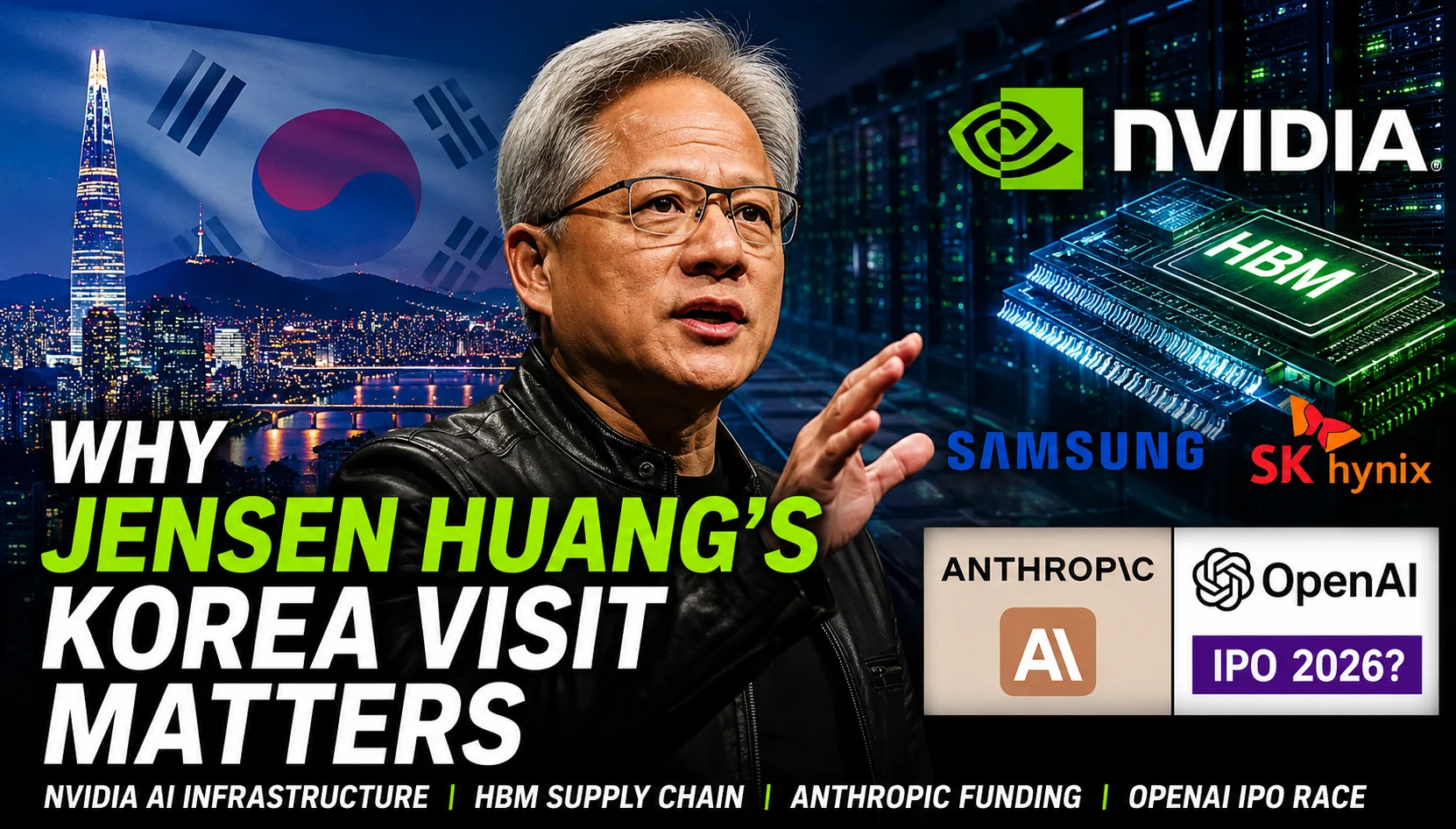
Why Jensen Huang’s Korea Visit Matters: Nvidia, HBM, Anthropic, and the OpenAI IPO Race
Jensen Huang’s expected Korea visit is not just another executive tour. It is a signal that AI competition has moved from model demos to supply chains: memory, GPUs, data centers, power, and public-market capital.
Jensen Huang is not visiting Korea to admire the AI boom. He is returning to inspect its plumbing.
Korean industry reports say Nvidia’s chief executive is expected to visit South Korea after Nvidia’s GTC Taipei 2026, which Nvidia lists for June 1–4 in Taipei. The reported agenda is telling: high-bandwidth memory (HBM), next-generation AI accelerators, advanced packaging, foundry cooperation, cloud AI, physical AI, and meetings with major Korean technology companies such as Samsung Electronics, SK hynix, LG, and NAVER. The trip has not been framed as a consumer-product launch. It looks more like an infrastructure alignment meeting.
That distinction matters. The AI race is no longer just about who has the best chatbot. It is about who can secure enough memory, chips, data-center sites, electricity, cooling, and capital to keep training and serving frontier AI systems. Korea sits directly in that bottleneck.
The simplest read: Nvidia needs Korea’s memory muscle
The most obvious reason for the trip is HBM.
HBM is the stacked, high-bandwidth memory that sits close to AI accelerators and feeds them data fast enough to keep expensive GPUs busy. Without enough advanced memory, even the best AI accelerator becomes underused silicon. That is why Samsung Electronics and SK hynix matter so much to Nvidia.
BusinessKorea reported that Huang is expected to discuss HBM, next-generation AI accelerators, advanced packaging, and foundries with Korean semiconductor companies after GTC Taipei. The same report notes that Samsung Electronics and SK hynix are considered core pillars of Nvidia’s AI semiconductor supply chain.
Samsung is trying to turn that moment into a comeback story. On May 29, 2026, Samsung said it had begun shipping samples of its 12-layer HBM4E to major global customers. The company says the new memory can scale up to 16Gbps, delivers up to 3.6 terabytes per second per stack, and is designed for large language models and next-generation AI systems. Samsung also says it will begin mass production in line with customer schedules.
SK hynix, meanwhile, has been rewarded by the market for its AI-memory position. Reuters reported on May 27, 2026, that SK hynix topped $1 trillion in market value for the first time, joining Samsung Electronics and Micron in the trillion-dollar club as AI data-center demand tightened memory supply and pushed prices higher.
Put bluntly: Nvidia designs the engines, but Korea helps supply the fuel line.
The second reason: Korea is becoming an AI-factory customer, not just a supplier
Korea’s role is not limited to selling components into Nvidia’s global machine. Nvidia is also helping turn Korea into a national-scale AI infrastructure customer.
At the 2025 APEC summit in Gyeongju, Nvidia announced that South Korea’s government and major companies would deploy more than 260,000 Nvidia GPUs across sovereign clouds and industrial AI factories. The plan included more than 50,000 GPUs for the Korean government’s AI infrastructure, more than 50,000 each for Samsung Electronics and SK Group, 50,000 Blackwell GPUs for Hyundai Motor Group, and more than 60,000 GPUs for NAVER Cloud.
Reuters separately reported that Nvidia would supply more than 260,000 advanced AI chips to South Korea’s government and major companies, with Samsung, SK Group, Hyundai, and NAVER among the key recipients. Reuters also noted an important caveat: Nvidia did not disclose the deal value or supply schedule.
That makes Huang’s return meaningful. The next phase is likely less about announcing an ambition and more about turning that ambition into buildout plans: where the GPUs go, who gets capacity first, what workloads they serve, how power is secured, and which Korean companies become anchor tenants of the AI-factory model.
The expected ripple effects
The visit’s impact will probably spread across five layers.
| Area | Likely effect | The caveat |
|---|---|---|
| HBM and memory | Samsung and SK hynix gain more strategic leverage as Nvidia, Anthropic, OpenAI, and cloud providers fight for memory supply. | Qualification, yield, and delivery timing still decide who wins actual volume. |
| Advanced packaging and foundry | Korea gets a chance to move beyond memory into higher-value AI semiconductor integration. | This is the hardest layer to displace incumbents in, and no reported visit equals a confirmed production order. |
| AI factories | Samsung, SK, Hyundai, NAVER, and the Korean government can use Nvidia systems for manufacturing, robotics, autonomous driving, Korean-language models, and sovereign AI. | GPU ownership does not automatically create software leadership. Utilization, talent, and datasets matter. |
| Data centers and power | More AI infrastructure means more demand for grid planning, cooling, and regional data-center sites outside Seoul. | Energy and permitting could become the real bottlenecks. |
| Capital markets | Korea’s chipmakers may continue to be priced as AI infrastructure assets, not old-cycle memory names. | AI enthusiasm can overshoot; memory remains cyclical even when demand feels structural. |
The key point is that Korea may capture value at both ends of the stack: upstream through HBM and semiconductors, and downstream through AI factories, cloud services, robotics, and industrial applications.
Anthropic just made the Korea angle louder
Anthropic’s latest funding news is a direct signal that frontier AI companies are becoming infrastructure companies.
On May 28, 2026, Anthropic announced a $65 billion Series H funding round at a $965 billion post-money valuation. The company said its run-rate revenue crossed $47 billion earlier in May and that the funding would help expand compute to meet demand for Claude. The important Korea connection is in the same announcement: Anthropic named Micron, Samsung, and SK hynix as strategic infrastructure partners, saying their technologies are critical to memory, storage, and logic-chip supply.
That is a clean tell. Anthropic is not simply buying cloud credits and hiring researchers. It is tying itself to the physical supply chain that makes model scaling possible. For Samsung and SK hynix, that is not just a sales opportunity. It is a seat closer to the planning table of frontier AI infrastructure.
OpenAI’s expected IPO raises the stakes
OpenAI adds another layer to the same story.
Reuters reported on May 20, 2026, that OpenAI was preparing to confidentially file for a U.S. IPO in the coming weeks, was aiming to go public as early as September, and was working with Goldman Sachs and Morgan Stanley on a draft prospectus. Reuters said OpenAI had last been valued at $852 billion and that earlier discussions had contemplated an offering that could value it at up to $1 trillion.
OpenAI has not turned the IPO story into a clean official timetable. So the careful wording is this: OpenAI is reported to be preparing for a potential IPO; a public listing date is not confirmed by the company.
The structural groundwork is easier to see. OpenAI said in 2025 that its for-profit entity would transition to a Public Benefit Corporation under the control of the OpenAI nonprofit, with the nonprofit becoming a large shareholder. That structure matters because public-market investors need a clearer capital structure before buying into a company at extreme scale.
OpenAI has already pulled Korea into its infrastructure map. In October 2025, OpenAI announced strategic partnerships with Samsung and SK as part of the Stargate initiative. The companies said Samsung Electronics and SK hynix would target 900,000 DRAM wafer starts per month at accelerated capacity rollout, while OpenAI would explore next-generation AI data centers in Korea with the Korean Ministry of Science and ICT, SK Telecom, and Samsung affiliates.
The bigger picture is simple: if OpenAI and Anthropic are both raising or preparing to access enormous pools of capital, then memory suppliers, GPU suppliers, energy providers, and data-center operators become part of the investment story.
The part people may underestimate: power and regional infrastructure
AI infrastructure is not only a chip story. It is an electricity story.
The International Energy Agency projects global data-center electricity consumption to more than double to around 945 TWh by 2030, with AI as the most important growth driver. That is why Korea’s AI push cannot succeed through GPU purchases alone.
The Korean Ministry of Science and ICT has already framed the National AI Computing Center as critical infrastructure for national and business competitiveness. Its establishment plan calls for public-private cooperation, an SPC structure, expanded GPU access for industry and academia, domestic AI semiconductor adoption, and policy support including power-system impact assessment.
That last phrase matters. The more Korea attracts AI factories, sovereign cloud projects, and frontier-model partnerships, the more the bottleneck shifts from “Can we buy GPUs?” to “Can we power and operate them efficiently?”
What this means for Korea
For Korea, Huang’s visit is a chance to strengthen three positions at once.
First, Korea can defend its memory dominance at a moment when HBM has become one of the most valuable parts of the AI stack. Second, it can use Nvidia’s AI-factory model to upgrade its strongest industries: semiconductors, autos, shipbuilding, robotics, telecom, and internet platforms. Third, it can make itself harder to bypass in the global AI supply chain by becoming both a supplier and a deployment market.
The risk is that Korea becomes too dependent on outside platforms. Nvidia supplies the compute platform. OpenAI and Anthropic supply frontier models. Hyperscalers supply cloud distribution. Korea’s strategic upside depends on whether its companies can turn infrastructure access into durable software, industrial AI, and sovereign model capability.
The best outcome is not “Korea buys many GPUs.” The best outcome is “Korea uses AI factories to make chips, cars, robots, language models, and industrial systems that others want to buy.”
Bottom line
Jensen Huang’s expected Korea visit is best read as a supply-chain and infrastructure signal.
Nvidia needs Korean HBM, packaging capability, industrial customers, and national-scale AI deployments. Korea needs Nvidia’s AI platform to stay relevant in the next manufacturing cycle. Anthropic’s near-trillion-dollar valuation and OpenAI’s reported IPO preparation make the same point from the capital-markets side: frontier AI is becoming too capital-intensive to separate software from infrastructure.
The old AI story was about who had the smartest model. The new AI story is about who controls the factory that makes intelligence cheap enough to use everywhere.
FAQ
Is Jensen Huang’s Korea visit officially confirmed?
As of May 29, 2026, Korean industry media report that Huang is expected to visit South Korea after Nvidia’s GTC Taipei 2026. Nvidia’s official GTC Taipei page confirms the June 1–4 event in Taipei, but the Korea visit itself should be treated as reported, not as a fully detailed official itinerary.
Why is Korea so important to Nvidia?
Korea is central to Nvidia because Samsung Electronics and SK hynix are major players in high-bandwidth memory, and because Korean companies such as Samsung, SK Group, Hyundai, and NAVER are also becoming large AI-infrastructure customers.
What is HBM, and why does it matter?
High-bandwidth memory is stacked memory used near AI accelerators to move data quickly. It matters because advanced AI chips need enormous memory bandwidth; without it, GPU clusters cannot run efficiently.
How does Anthropic connect to Korea?
Anthropic named Samsung and SK hynix, along with Micron, as strategic infrastructure partners in its May 2026 funding announcement. That links Korean memory suppliers directly to the compute expansion plans of one of the world’s leading frontier AI companies.
Is OpenAI definitely going public in 2026?
No. Reuters has reported that OpenAI is preparing a confidential IPO filing and could aim for a public debut as early as September 2026, but OpenAI has not announced a fixed listing date. Treat the IPO as a reported plan, not a completed event.
What is the biggest risk behind the Nvidia-Korea AI buildout?
The biggest risk is execution. Korea needs not only GPUs and HBM but also power, cooling, data-center capacity, software talent, and real industrial AI use cases. Hardware access is the starting line, not the finish line.
Sources
- BusinessKorea: “Jensen Huang Visits South Korea Next Week” — May 28, 2026. Used for reported Korea visit agenda.
- Nvidia: GTC Taipei 2026 — Event page accessed May 29, 2026. Used for official GTC Taipei dates and themes.
- Nvidia Newsroom: South Korea Government and Industrial Giants Build AI Infrastructure — October 30, 2025. Used for Nvidia’s Korea AI infrastructure announcements.
- Reuters: Nvidia to supply more than 260,000 Blackwell AI chips to South Korea — October 31, 2025. Used for independent confirmation and deal caveats.
- Nvidia Newsroom: Q1 FY2027 financial results — May 20, 2026. Used for Nvidia revenue and data-center demand context.
- Samsung Global Newsroom: Samsung Electronics Begins Shipment of Industry-First HBM4E Samples — May 29, 2026. Used for HBM4E specifications and shipment status.
- Reuters: SK Hynix joins $1 trillion club after Samsung, Micron on AI chip boom — May 27, 2026. Used for market impact of AI memory demand.
- Anthropic: Series H funding announcement — May 28, 2026. Used for Anthropic valuation, revenue run-rate, compute plans, and Korean memory partners.
- Reuters: OpenAI aiming for speedy IPO — May 20, 2026. Used for reported IPO timing and valuation context.
- OpenAI: Evolving OpenAI’s structure — May 5, 2025. Used for Public Benefit Corporation structure context.
- OpenAI: Samsung and SK join Stargate — October 1, 2025. Used for Stargate Korea, memory production targets, and data-center cooperation.
- Korea Ministry of Science and ICT: National AI Computing Center Establishment Plan — January 22, 2025. Used for Korean national AI infrastructure policy.
- International Energy Agency: Energy demand from AI — 2025 report page. Used for data-center electricity demand projection.