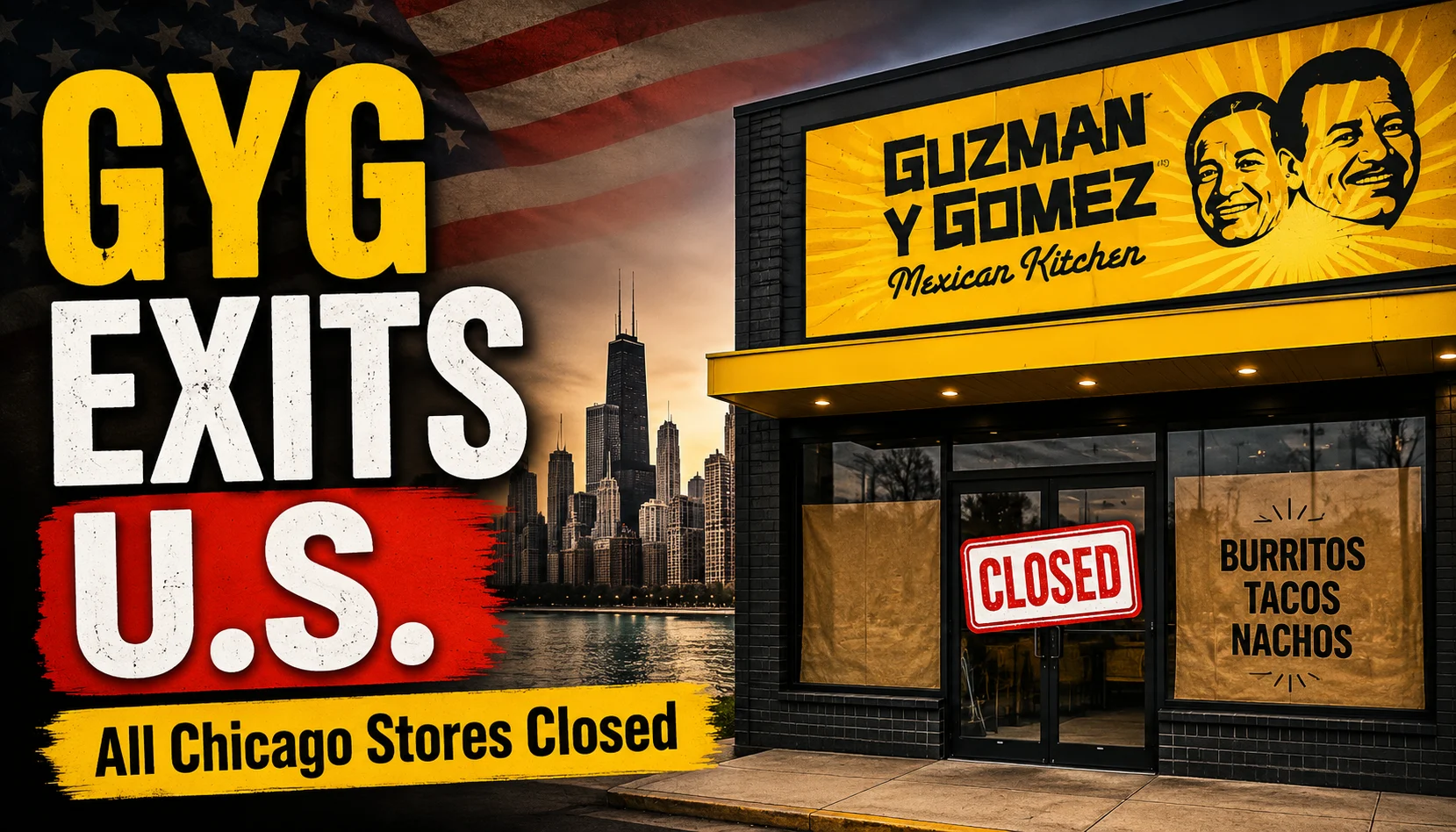
Guzman y Gomez U.S. Closures: Why the Australian Mexican Chain Abandoned America
Guzman y Gomez did not close its U.S. restaurants because Americans stopped eating burritos. It closed them because eight Chicago-area stores could not justify the time, capital, and operating losses required to build a serious U.S. fast-casual business.
The headline is simple: Guzman y Gomez has exited the United States. The more interesting story is what the exit says about global restaurant expansion.
On May 22, 2026, Guzman y Gomez Limited, the Australian-listed Mexican fast-food chain often shortened to GYG, told investors it would exit the U.S. market and cease trading its Chicago restaurants immediately. The company said the U.S. business was not meeting its targeted hurdles, and founder/co-CEO Steven Marks said the brand’s food and guest experience were not translating into enough sales momentum to justify continued shareholder investment. GYG ASX announcement, May 22, 2026
For global readers, one clarification matters: Guzman y Gomez is not a Mexico-based company. It is an Australian company selling Mexican-style fast food. It was founded in Sydney in 2006 by New Yorkers Steven Marks and Robert Hazan, expanded first in Australia, then into Singapore and Japan, and is listed on the Australian Securities Exchange. GYG About page
At a glance: what changed in May 2026
| Question | Answer |
|---|---|
| What happened? | GYG exited the U.S. market and closed its Chicago-area restaurants with immediate effect. |
| How many U.S. restaurants were involved? | Public company reporting showed 8 U.S. restaurants at the end of December 2025; restaurant trade reporting also described eight domestic locations in the Chicago area. GYG 1H26 results, Nation’s Restaurant News |
| Effective date | May 22, 2026. |
| Main reason given by GYG | U.S. financial performance was not acceptable and the network would require more time and capital than expected. GYG ASX announcement |
| Estimated financial hit | A one-off profit-and-loss impact of US$30 million to US$40 million in FY2026; cash exit costs are not expected to exceed US$15 million. GYG ASX announcement |
| Where GYG will focus now | Australia remains the core growth engine, with Singapore and Japan continuing under master franchise partners. GYG ASX announcement |
| Latest complication | Former U.S. employees have filed a lawsuit alleging insufficient notice before closure; GYG says it believes it met its legal obligations. Reuters, May 25, 2026 |
The important part: this was a strategy retreat, not a brand death
GYG’s U.S. closure can sound dramatic because the company had once framed America as a major growth market. In restaurant terms, though, the exit was less a collapse than a capital-allocation decision.
By the end of December 2025, GYG’s U.S. segment had eight restaurants and reported A$8.2 million in network sales for the first half of FY2026, up from A$4.9 million a year earlier. That growth looks healthy until the loss line appears: U.S. segment underlying EBITDA was negative A$8.3 million in 1H26, compared with negative A$5.0 million in 1H25. Corporate restaurant margin was also deeply negative at -69.6% for the period. GYG 1H26 results
That is the central tension. GYG was growing U.S. sales, but not in a way that proved the model could scale profitably. The company’s May 2026 announcement effectively said: the upside is not worth the burn.
Why the U.S. expansion became so hard
The obvious explanation is “competition,” but that word is too vague. The U.S. market was hard for GYG for at least four overlapping reasons.
1. The U.S. Mexican fast-casual category already has scale players
GYG was not entering a white-space market. It was entering the home turf of major fast-casual Mexican brands, especially Chipotle.
Chipotle reported 3,938 U.S. restaurants and 104 international restaurants as of December 31, 2025, plus 14 international partner-operated restaurants. It also opened 334 company-owned restaurants in 2025 and expected approximately 350 to 370 openings in 2026. Chipotle 2025 Form 10-K, SEC
That scale matters. A small entrant can have better food, sharper branding, or stronger operations and still struggle if it lacks density. Density affects supply chain efficiency, delivery economics, local marketing, labor coverage, management oversight, and customer habit formation. In a market like Chicago, eight stores can create visibility; they do not create inevitability.
2. GYG’s U.S. store base was too small to absorb heavy setup costs
New restaurant markets are expensive before they are proven. A company has to build supplier relationships, hire above-restaurant leadership, train teams, localize marketing, choose locations, handle leases, pay delivery-platform costs, and keep standards consistent across a new geography.
GYG’s own half-year report showed the problem in numbers. In 1H26, U.S. general and administrative costs were A$4.0 million, equal to 48.2% of U.S. network sales. That was an improvement from 78.1% the year before, but it still meant the infrastructure was very heavy relative to sales. GYG 1H26 results
This is what “more time and capital” means in plain English: GYG would likely have needed to keep spending before it could know whether a larger U.S. network would work.
3. The restaurant cost environment gave weak stores less room to breathe
The U.S. restaurant industry entered 2026 with continued menu-price pressure. In April 2026, the U.S. Bureau of Labor Statistics reported that the food away from home index rose 3.6% over the prior 12 months; limited-service meals rose 3.2% over the same period. U.S. Bureau of Labor Statistics CPI release, April 2026
That does not mean inflation “caused” GYG’s exit. GYG’s official explanation focused on sales momentum, capital requirements, and financial hurdles. But inflation makes underperforming expansion markets less forgiving. When labor, ingredients, occupancy, and delivery costs remain elevated, a small store base has fewer ways to hide mistakes.
4. The brand had to educate American customers in a category they already understood
This is the paradox. GYG’s Australian success came partly from bringing fast, fresh Mexican-style food to a market where it could feel differentiated. In the U.S., many consumers already know burritos, bowls, tacos, salsa bars, value meals, and mobile ordering. The product may still be good, but “good” is not the same as habit-changing.
The company’s announcement was unusually clear on this point. GYG said it remained confident in the food and guest experience, but that confidence was not turning into sufficient sales momentum. GYG ASX announcement
The Chicago choice: useful test market, difficult launchpad
GYG entered the U.S. through the Chicago area. Nation’s Restaurant News reported that the chain debuted in Naperville, Illinois, in January 2020 and later expanded across the Chicago market, including Bucktown, Schaumburg, Evanston, Crystal Lake, Deerfield, Buffalo Grove, and Des Plaines. Nation’s Restaurant News
Chicago has advantages: scale, suburbs, universities, commuting corridors, and food-savvy consumers. But it is also a crowded restaurant market with high operating complexity. For a foreign brand, it is not enough to open a few strong restaurants. The harder task is building a repeatable playbook: which real estate works, which dayparts matter, how much local marketing is needed, how delivery affects margins, and how quickly new stores mature.
GYG’s May 2026 decision suggests that the Chicago playbook did not become convincing quickly enough.
Why investors appeared to welcome the exit
At first glance, closing an entire country operation should look like bad news. Reuters reported, however, that GYG shares rose as much as 20% after the U.S. exit announcement. Reuters, May 22, 2026
That reaction makes sense if investors saw the U.S. business as a drag rather than an option. A costly expansion story is attractive only while investors believe the future payoff is large enough. Once that belief weakens, shutting the loss-making experiment can look like discipline.
GYG also paired the exit with a stronger message on Australia. The company said Australia remains its core focus, that it remained on track to open 32 restaurants in Australia in FY2026, and that it expected Australia Segment underlying EBITDA of approximately A$85 million in FY2026, representing 29% growth on the prior year. GYG ASX announcement
The market read was blunt: fewer U.S. losses, more focus on the home-market growth engine.
What happens to GYG now?
GYG is not retreating from international business entirely. It is retreating from this U.S. model.
In the same May 2026 announcement, the company said the U.S. decision was not a statement about GYG’s global potential. It pointed to Singapore and Japan, where master franchise partners continued to deliver sales growth and healthy unit economics, and said both markets were planning new restaurant openings in the next 12 months. GYG also said Singapore had opened its 24th restaurant earlier that week. GYG ASX announcement
GYG’s public website now describes the company as operating over 260 restaurants in Australia, Singapore, and Japan. GYG About page
The new strategy is therefore narrower, not smaller in ambition: build where the unit economics are already stronger, and be more disciplined about where capital goes next.
The legal wrinkle: former U.S. workers have sued
The U.S. closures also created a labor-law dispute.
Reuters reported on May 25, 2026 that a group of former U.S. employees filed a lawsuit in Illinois alleging GYG failed to provide advance notice before closing its U.S. operations. The report said the complaint estimated roughly 500 employees could be affected and sought wages and benefits under federal and state WARN laws. GYG told Reuters it was aware of the legal action and was confident it had met its legal obligations. Reuters, May 25, 2026
The federal Worker Adjustment and Retraining Notification Act, commonly called the WARN Act, generally requires covered employers with 100 or more employees to provide 60 calendar days’ advance notice of certain plant closings and mass layoffs. U.S. Department of Labor Illinois also has a state WARN Act requiring covered employers with 75 or more full-time employees to give 60 days’ advance notice of certain plant closings or mass layoffs. Illinois Department of Labor
This lawsuit should be treated separately from the business strategy question. The business question is why GYG exited. The legal question is whether the closure process complied with applicable notice laws. As of this article’s last update, that legal issue had not been resolved.
The bigger lesson for global restaurant chains
GYG’s U.S. exit is a useful case study because it challenges a lazy assumption: that a popular domestic restaurant brand can simply “take the concept to America” and scale.
A better test is this:
- Is the product differentiated in the target market, not just at home?
- Can the brand create enough local density before losses become politically or financially painful?
- Do early stores show a path to attractive unit economics without heroic marketing spend?
- Can the company localize operations without diluting what made the brand work?
- Is the expansion model appropriate: company-owned, franchise, master franchise, joint venture, or licensing?
GYG’s Asian markets appear to be following a different model through master franchise partners. The U.S. market, by contrast, required the company to shoulder a heavier proof-of-concept burden. That distinction may matter more than cuisine.
What people may misunderstand
Misreading 1: “Americans rejected GYG’s food.”
The official record does not support such a simple claim. GYG said the issue was that its food and guest experience were not translating into enough sales momentum to justify the required investment. That is a business-model problem, not necessarily a product-quality verdict.
Misreading 2: “GYG is giving up on global expansion.”
No. The company says the U.S. exit is specific to the U.S. and continues to point to Singapore and Japan as attractive international markets.
Misreading 3: “The closure proves the U.S. Mexican fast-casual category is weak.”
Not really. Chipotle’s U.S. footprint shows the category can be huge. The issue is that a late entrant must win against incumbents with far greater scale, operating data, brand awareness, and real estate experience.
Misreading 4: “A share-price jump means the exit was a success.”
Not exactly. It means investors may have preferred stopping losses to continuing an uncertain expansion. The one-off exit cost is still material, and the company still has to execute in Australia and Asia.
Final take
GYG’s U.S. exit is not the end of Guzman y Gomez. It is the end of a particular story: the idea that a high-growth Australian Mexican fast-food brand could use Chicago as the first step toward a major American rollout.
The company now has a cleaner narrative, but also less room for mythology. The next phase will be judged less by global ambition and more by repeatable restaurant economics.
That is the quiet lesson in the closures: international expansion is not won by being interesting. It is won by becoming inevitable, store by store.
FAQ
Did Guzman y Gomez close all U.S. restaurants?
Yes. GYG announced on May 22, 2026 that it would exit the U.S. market and cease trading its Chicago restaurants with immediate effect. Restaurant trade reporting and GYG’s prior public filings indicate the U.S. network had eight restaurants.
Why did Guzman y Gomez abandon U.S. expansion?
GYG said U.S. financial performance was not acceptable, sales momentum was not improving enough, and the business would require significantly more time and capital than expected. The company concluded the current U.S. network was unlikely to justify continued investment of shareholder capital.
Where were GYG’s U.S. restaurants?
The U.S. business was concentrated in the Chicago area. Nation’s Restaurant News reported locations including Naperville, Bucktown, Schaumburg, Evanston, Crystal Lake, Deerfield, Buffalo Grove, and Des Plaines.
How much will the U.S. exit cost GYG?
GYG expects a one-off profit-and-loss impact of US$30 million to US$40 million in its FY2026 results. The company said the cash component is not expected to exceed US$15 million.
Is Guzman y Gomez still operating outside Australia?
Yes. After the U.S. exit, GYG continues to operate in Australia, Singapore, and Japan. The company says its Singapore and Japan master franchise partners remain part of its international growth outlook.
Is the U.S. closure connected to a lawsuit?
A lawsuit was filed after the closures by former U.S. employees alleging insufficient advance notice under WARN laws. GYG told Reuters it believes it met its legal obligations. The lawsuit is a post-closure legal issue and should not be treated as a settled finding.
Is Guzman y Gomez a Mexican company?
No. Guzman y Gomez is an Australian company founded in Sydney in 2006 by Steven Marks and Robert Hazan. It sells Mexican-style fast food and is listed on the Australian Securities Exchange.
Sources
- Update on US strategy and Australia Segment guidance — Guzman y Gomez Limited / ASX, May 22, 2026. Used for: official U.S. exit announcement, rationale, estimated exit cost, Australia guidance, Singapore/Japan outlook.
- 2026 GYG Half-Year Result ASX Announcement — Guzman y Gomez Limited / ASX, February 20, 2026. Used for: 1H26 U.S. segment sales, restaurant count, margins, and underlying EBITDA loss.
- About Guzman y Gomez — Guzman y Gomez official website, accessed May 28, 2026. Used for: founding details, countries of operation, global restaurant count, ASX listing context.
- Guzman y Gomez has exited the U.S. market — Nation’s Restaurant News, May 26, 2026. Used for: U.S. debut timing and Chicago-area location list.
- Australia’s Guzman y Gomez to exit US in retreat from key growth bet — Reuters, May 22, 2026. Used for: market reaction, U.S. expansion reversal context, investor framing.
- Australia’s Guzman y Gomez sued in US over alleged failure to notify staff of closure — Reuters, May 25, 2026. Used for: post-closure lawsuit and GYG response.
- Consumer Price Index Summary — April 2026 — U.S. Bureau of Labor Statistics, May 2026. Used for: food-away-from-home and limited-service meal inflation context.
- Chipotle Mexican Grill 2025 Form 10-K — U.S. Securities and Exchange Commission, filed 2026. Used for: Chipotle U.S. restaurant count, expansion scale, and restaurant-development context.
- Plant Closings and Layoffs — U.S. Department of Labor, accessed May 28, 2026. Used for: federal WARN Act overview.
- Worker Adjustment and Retraining Notification Act — Illinois Department of Labor, accessed May 28, 2026. Used for: Illinois WARN Act overview.