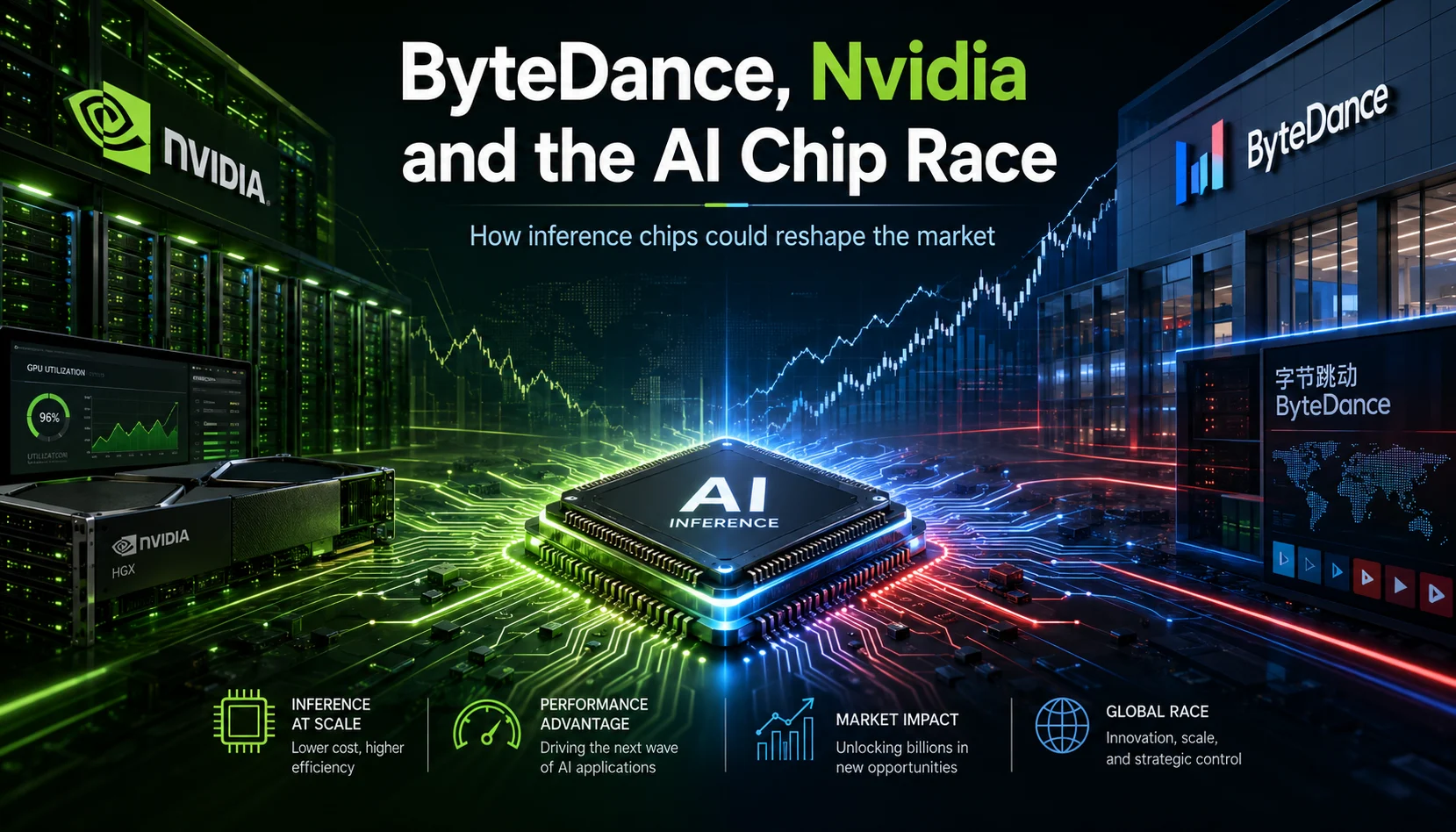
Nvidia, ByteDance, and the AI Chip Race: Why Inference Is the New Battleground
ByteDance’s reported AI chip push is not a simple attempt to “beat Nvidia.” It is a sign that the AI market is moving from buying scarce GPUs to controlling the whole economics of inference: chips, memory, software, data centers, and regulation.
The headline sounds like a direct challenge: ByteDance is developing AI chips like those from Nvidia partner Groq. The more useful reading is subtler. ByteDance still appears to need Nvidia-class compute where it can get it. At the same time, it is reportedly trying to build or source custom chips for the parts of AI infrastructure where control, latency, supply security, and cost matter most.
That distinction matters. Nvidia’s lead is not only a chip lead. It is a full-stack lead: GPUs, CPUs, networking, rack-scale systems, software, developer habits, and supply-chain priority. ByteDance’s opportunity is not to clone that overnight. It is to reduce dependence in specific workloads, especially inference, where trained AI models generate answers, recommendations, videos, agent actions, and enterprise outputs.
This article is a general technology and market explainer, not investment advice.
What is an AI chip?
An AI chip is a processor designed or optimized to run the math behind artificial intelligence systems. That usually means large volumes of matrix multiplication, memory movement, and low-precision numerical computation for machine learning, deep learning, and large language models. IBM describes AI chips as microchips built specifically to handle AI tasks such as machine learning, data analysis, and natural language processing. IBM also uses the broader term “AI accelerator” for hardware built to speed AI neural networks and machine learning workloads.
AI chips are not one thing. The category includes general-purpose GPUs used for AI, custom ASICs, neural processing units, tensor processors, inference accelerators, and sometimes CPUs that are tightly paired with accelerators.
| Chip type | What it does well | Why it matters in this story |
|---|---|---|
| GPU | Flexible parallel compute for training and inference | Nvidia dominates this layer, especially in large data centers. |
| ASIC | A custom chip built for a specific workload | ByteDance, Google, Amazon, Meta, Broadcom customers, Marvell customers, and others use this path to lower cost or improve efficiency. |
| NPU / AI accelerator | Specialized neural-network processing | Common in phones, PCs, edge devices, and some servers. |
| LPU-style inference chip | Low-latency language-model inference | Groq’s pitch is that a purpose-built inference architecture can produce tokens quickly and efficiently. |
| CPU | General orchestration, pre/post-processing, data movement, agent workflows | As inference and agents grow, CPUs become more important alongside GPUs. |
Put simply: GPUs made the AI boom possible. But as AI moves from training giant models to serving billions of responses, the market is looking for cheaper, lower-latency, more energy-efficient chips.
What ByteDance appears to be doing
The Information’s public article page identifies the story as “China’s ByteDance Developing New AI Chips Like Those from Nvidia Partner Groq,” but the full story is subscriber-only. The surrounding reporting from Reuters, SCMP, Nvidia, BIS, and company materials points to a broader strategy: ByteDance is assembling a multi-track compute supply chain rather than betting everything on one chip.
First, Reuters reported in February 2026 that ByteDance was developing an AI inference chip and had been in talks with Samsung Electronics to manufacture it. The reported goal was at least 100,000 units in 2026, with a possible ramp toward 350,000. Reuters also reported that the talks included access to scarce memory supply, and that ByteDance planned more than 160 billion yuan in AI-related procurement in 2026. ByteDance said information about the in-house chip project was inaccurate, without elaborating.
Second, Reuters reported on May 26, 2026, citing Bloomberg, that Qualcomm had reached a deal to supply ByteDance with AI data center ASICs. The report said ByteDance could procure millions of Qualcomm chips to support AI agent software and that the arrangement could help turn ByteDance’s completed in-house design into production-ready silicon. Reuters noted that it could not independently verify the report, and Qualcomm and ByteDance did not immediately comment.
Third, Reuters reported on May 28, 2026, that ByteDance was developing custom CPUs for AI infrastructure. That matters because inference is not only a GPU problem. Agentic systems need CPUs to coordinate tools, memory, retrieval, scheduling, and data movement. Reuters said ByteDance was exploring both Arm and RISC-V architecture tracks and wanted to deploy proprietary CPUs in its own servers and data centers.
Fourth, ByteDance is still a major buyer or seeker of Nvidia-class compute. Reuters reported in March 2026 that ByteDance was working with Aolani Cloud to deploy about 500 Nvidia Blackwell computing systems in Malaysia, totaling roughly 36,000 B200 chips, for AI research and global demand outside China. SCMP also reported that ByteDance planned to spend about 100 billion yuan, or roughly $14 billion, on Nvidia AI chips in 2026 if H200 sales into China were allowed.
Put together, ByteDance’s strategy looks less like “replace Nvidia” and more like this:
- Use Nvidia where performance and availability allow.
- Build inference accelerators where ByteDance has predictable, high-volume workloads.
- Develop CPUs and supporting silicon to reduce system-level bottlenecks.
- Partner with companies such as Samsung, Qualcomm, and possibly foundries or packaging providers where internal design alone is not enough.
- Keep options open because U.S.-China chip policy can change faster than a semiconductor roadmap.
Why ByteDance cares so much about inference
Training is the expensive process of creating or improving a model. Inference is what happens every time a trained model answers a prompt, recommends a video, summarizes a document, powers an agent, or generates code.
For ByteDance, inference is not a side workload. It sits close to the center of the business. ByteDance’s Seed team said in February 2026 that its LLM series supports consumer products with hundreds of millions of users, including Doubao, and that the agent era raises demand for long-context, multi-step, production-scale deployment. It also said Seed2.0 offers multiple model sizes and faster, more flexible inference options.
That is why a Groq-like framing is important. Groq’s own materials describe its Language Processing Unit, or LPU, as purpose-built for inference, with design principles such as deterministic compute, a programmable assembly-line architecture, and on-chip memory. Nvidia’s Groq 3 LPX page describes an inference accelerator for the Vera Rubin platform that combines Rubin GPUs and LPUs for low-latency, large-context agentic systems.
The market is gradually discovering that an answer token is a unit of cost. If a chatbot, video agent, search assistant, or enterprise agent produces billions or trillions of tokens, even small improvements in latency, power use, and utilization become large economic advantages.
Why Nvidia is still hard to dislodge
Nvidia’s strength is not just that it sells powerful chips. It sells the default AI computing environment.
In its fiscal 2026 annual report, Nvidia describes its data center platform as a combination of GPUs, CPUs, interconnects, networking, software, AI models, SDKs, APIs, and domain-specific frameworks. The company also emphasizes CUDA and its full-stack approach. That is the moat: customers are buying an ecosystem, not a loose component.
The numbers explain why challengers are circling. Nvidia reported record fiscal 2026 revenue of $215.9 billion, up 65% year over year, and full-year data center revenue of $193.7 billion, up 68%. In its latest financial report page, Nvidia said first-quarter fiscal 2027 revenue was $81.6 billion, with record data center revenue of $75.2 billion.
That scale gives Nvidia three advantages.
First, it can co-design across the entire system. Blackwell and Vera Rubin are not merely GPUs; they are rack-scale platforms. Nvidia’s annual report says Rubin is expected to ship in the second half of fiscal 2027 and is built for agentic AI, reasoning, and long-context workflows.
Second, Nvidia has software gravity. Developers, cloud providers, model labs, and enterprise AI teams have spent years optimizing around CUDA, Nvidia networking, and Nvidia inference libraries. A cheaper chip can still lose if it takes too much engineering effort to use.
Third, Nvidia can absorb and integrate threats. Reuters reported that Groq signed a $17 billion licensing deal with Nvidia in December 2025, and Nvidia’s own annual report references a non-exclusive license agreement with Groq. Nvidia’s LPX materials now present Groq 3 LPU accelerators as part of the Vera Rubin inference architecture.
In other words, even the “anti-GPU” inference story can become part of Nvidia’s platform story.
The market impact: five real shifts
1. Nvidia’s China problem becomes more structural
U.S. export controls and Chinese self-reliance policy have made China a difficult market for Nvidia. In January 2026, the U.S. Bureau of Industry and Security revised its license review policy for certain advanced chips, including Nvidia H200 and AMD MI325X equivalents, from a presumption of denial to case-by-case review under strict conditions. Reuters later reported that the U.S. had cleared around 10 Chinese firms, including ByteDance, to buy H200 chips, but no deliveries had been made as of May 14, 2026.
This is the core tension: Nvidia wants to sell, Chinese firms want performance, Washington wants controls, and Beijing wants domestic capability. ByteDance’s chip effort should be read inside that squeeze.
2. Custom ASIC suppliers gain negotiating power
The more predictable a workload becomes, the more attractive custom silicon becomes. Marvell, Broadcom, MediaTek, Qualcomm, and other design partners benefit when hyperscalers decide that buying only general-purpose GPUs is too expensive or too risky.
Reuters reported in March 2026 that Marvell’s upbeat forecast reflected booming demand for custom AI chips from large technology companies, and that Broadcom had projected more than $100 billion in AI-chip sales next year. Reuters also reported in May 2026 that MediaTek estimated the custom AI ASIC market could reach $70 billion to $80 billion in 2027.
ByteDance entering this lane reinforces the pattern. Big AI platforms increasingly want chips that fit their own models, traffic patterns, and cost targets.
3. Memory and packaging become as important as compute
AI chip competition is often described as Nvidia versus everyone else. That misses the bottleneck. The real constraint is increasingly the system: HBM, SRAM, advanced packaging, power, cooling, and interconnect.
IDC forecasts total semiconductor revenue of $1.29 trillion in 2026, with data center semiconductor revenue reaching $477.1 billion. IDC also identifies a $281 billion “intelligent” data center segment covering CPUs, AI accelerators, GPUs, custom ASICs, and networking silicon. Meanwhile, Reuters reported that TSMC sees energy efficiency, not raw compute alone, as the main constraint shaping future chip development.
This explains why ByteDance’s reported Samsung talks included memory access. A chip design without memory supply is a plan, not infrastructure.
4. The AI chip market fragments by workload
The first phase of generative AI rewarded whoever could get the most GPUs. The next phase rewards specialization.
Training frontier models still favors the largest, most flexible accelerator clusters. High-volume inference may favor custom ASICs, LPU-style accelerators, or hybrid GPU-plus-specialized systems. Agent workloads may increase demand for CPUs, networking, storage, and memory. Edge AI may use smaller NPUs.
Omdia forecast in 2025 that the AI data center chip market would reach $286 billion by 2030 and noted that alternatives to GPUs, including custom ASICs and merchant AI processors such as Huawei Ascend, Groq, and Cerebras, were gaining traction.
The practical result is not one winner. It is a layered market: Nvidia remains strongest at the full-stack premium layer, while custom silicon grows in high-volume, workload-specific lanes.
5. ByteDance could lower its AI cost curve, but only if the software works
Custom silicon is seductive because it promises lower unit cost. It is also brutal because every hardware saving can be eaten by software complexity.
That is the part investors and casual readers often miss. A chip is not useful just because it exists. It needs compilers, kernels, model support, memory management, monitoring, developer tools, supply guarantees, and operational reliability. Nvidia’s moat is partly that it has already solved much of that pain for customers.
For ByteDance, the upside is clear: cheaper inference for Doubao, TikTok-related AI features, Volcano Engine, agents, recommendation systems, and enterprise AI services. The risk is equally clear: if its custom chips are late, hard to program, power-hungry, or supply-constrained, ByteDance may still have to pay the Nvidia tax where it can access Nvidia hardware.
What to watch next
The most important signal is not whether ByteDance announces one chip. It is whether ByteDance can deploy custom silicon at meaningful volume in production systems.
Watch four things:
- Volume: Does production move from samples to tens or hundreds of thousands of deployed accelerators?
- Workload: Are the chips used for narrow inference tasks, general LLM serving, recommendation systems, agents, or cloud customers?
- Partners: Do Samsung, Qualcomm, TSMC-linked suppliers, memory vendors, or packaging providers become visible in the supply chain?
- Software: Does ByteDance build an internal software stack good enough to make custom hardware cheaper in practice, not only on paper?
The chip race is no longer only about who can copy Nvidia. It is about who can turn tokens into an owned supply chain.
FAQ
Is ByteDance trying to replace Nvidia?
Not completely. The available reporting suggests ByteDance is still seeking Nvidia-class compute while also developing or sourcing custom chips for specific workloads, especially inference and AI infrastructure control.
What makes an inference chip different from a training GPU?
Training GPUs need flexibility, massive memory bandwidth, and large-scale parallelism for building models. Inference chips can be optimized for serving trained models repeatedly, often with lower latency, better power efficiency, and lower cost per token.
Why is Groq relevant to ByteDance?
Groq is associated with LPU-style, inference-focused architecture. The Information’s public headline frames ByteDance’s reported chips as similar to those from Nvidia partner Groq, and Nvidia now presents Groq 3 LPX as an inference accelerator for its Vera Rubin platform.
Does this hurt Nvidia?
It adds pressure, especially in China and in high-volume inference workloads. But Nvidia’s platform scale, software ecosystem, networking, roadmap, and ability to integrate specialized inference technology mean ByteDance’s move is more likely to reshape parts of the market than erase Nvidia’s lead quickly.
Who benefits if ByteDance pushes harder into custom AI chips?
Potential beneficiaries include custom silicon partners, foundries, memory suppliers, advanced packaging companies, and networking vendors. Qualcomm, Samsung, MediaTek, Marvell, Broadcom, TSMC, and HBM suppliers all sit near the opportunity, though the winners depend on actual production contracts and export-control constraints.
Sources
- The Information — “China’s ByteDance Developing New AI Chips Like Those from Nvidia Partner Groq” — public article metadata; full article subscriber-only. Used for: topic framing.
- Reuters — “ByteDance developing AI chip, in manufacturing talks with Samsung, sources say” — February 11, 2026. Used for: reported inference chip, Samsung talks, production targets, ByteDance denial.
- Reuters — “Qualcomm strikes AI chip deal with TikTok owner ByteDance, Bloomberg News reports” — May 26, 2026. Used for: reported Qualcomm ASIC deal.
- Reuters — “ByteDance developing custom CPU chips to support AI rollout, sources say” — May 28, 2026. Used for: custom CPU plans, Arm/RISC-V tracks, inference shift.
- Reuters — “China’s ByteDance gets access to top Nvidia AI chips, WSJ reports” — March 13, 2026. Used for: reported overseas Nvidia B200 deployment through Aolani Cloud.
- South China Morning Post — “ByteDance to pour US$14 billion into Nvidia chips in 2026 as computing demand surges” — December 31, 2025. Used for: reported Nvidia chip budget and chip team context.
- ByteDance Seed Team — “Seed 2.0 Official Launch” — February 14, 2026. Used for: ByteDance model deployment and inference demand context.
- NVIDIA Newsroom — FY2026 financial results — February 25, 2026. Used for: Nvidia revenue, data center revenue, Blackwell/Rubin context.
- NVIDIA Investor Relations — latest financial report — accessed May 29, 2026. Used for: Q1 FY2027 revenue and data center revenue.
- NVIDIA FY2026 Form 10-K — February 25, 2026. Used for: Nvidia platform description, CUDA/full-stack moat, Groq licensing reference.
- NVIDIA — Groq 3 LPX — accessed May 29, 2026. Used for: LPU/LPX inference architecture and Nvidia’s Vera Rubin integration.
- Groq — “What is a Language Processing Unit?” — March 7, 2025. Used for: Groq LPU definition and architecture principles.
- U.S. Bureau of Industry and Security — “Department of Commerce Revises License Review Policy for Semiconductors Exported to China” — January 13, 2026. Used for: H200/MI325X license review policy.
- Federal Register — “Revision to License Review Policy for Advanced Computing Commodities” — January 15, 2026. Used for: export-control rule details.
- Reuters — “US clears H200 chip sales to 10 China firms as Nvidia CEO looks for breakthrough” — May 14, 2026. Used for: approved buyers, stalled deliveries, China/Nvidia market context.
- IDC — “Semiconductor Market Forecast 2026: The AI Supercycle Arrives” — April 29, 2026. Used for: 2026 semiconductor and data center semiconductor forecasts.
- Omdia — “AI data center chip market to hit $286bn” — August 28, 2025. Used for: AI data center chip forecast and custom ASIC trend.
- Reuters — “Energy use forcing rethink of AI chip design, TSMC says” — May 28, 2026. Used for: energy efficiency and packaging constraints.
- Reuters — “Marvell Tech shares soar on bullish multi-year AI chip outlook” — March 6, 2026. Used for: custom AI chip demand and ASIC definition.
- Reuters — “Taiwan’s MediaTek says it supports both TSMC and Intel’s advanced packaging technologies” — May 29, 2026. Used for: custom AI ASIC TAM estimate and packaging context.