SpaceX’s IPO Test: Defense Momentum Meets a Governance Discount
 Jay Jung
SpaceX’s IPO case is getting stronger on strategic relevance and weaker on governance comfort at the same time.
Key takeaways
- As of May 30, 2026, SpaceX’s IPO had not priced; Reuters reported a possible June 12 Nasdaq listing under the ticker SPCX, with a target raise of about $75 billion at roughly a $1.75 trillion valuation. (Reuters)
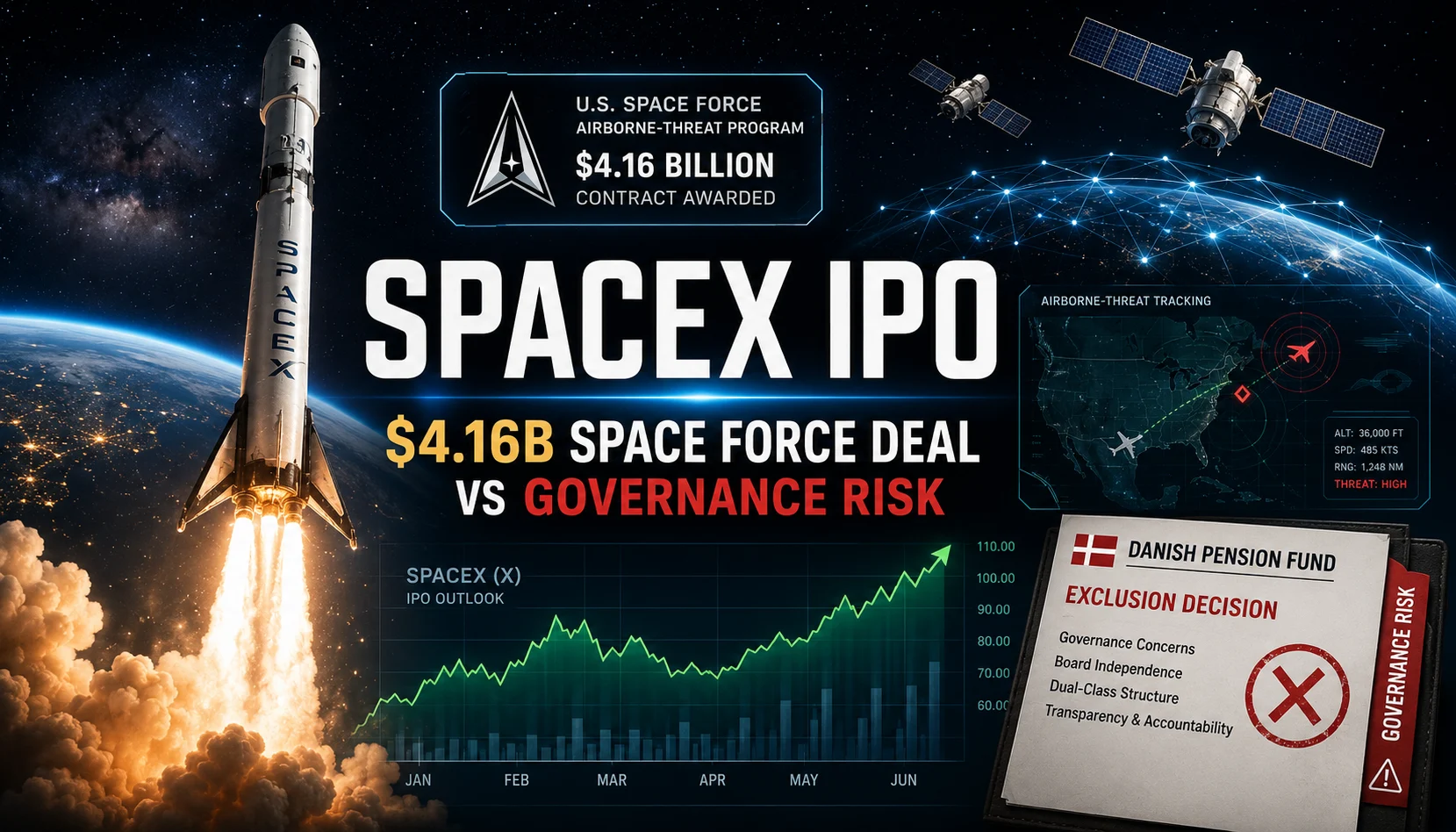
- The U.S. Space Force awarded SpaceX a $4.16 billion contract for the Space-Based Airborne Moving Target Indicator program, or SB-AMTI, to help track and target airborne threats from space. (Space Systems Command)
- The award sits beside a separate $2.29 billion Space Data Network Backbone contract, making SpaceX more central to U.S. missile-defense and military data-transport plans. (Reuters)
- Danish pension fund AkademikerPension placed SpaceX on its exclusion list, citing governance and valuation concerns, including Elon Musk’s expected voting control and combined CEO, CTO, and board-chair roles. (Reuters)
- The cleanest way to read the IPO is a three-gate test: capability, cash flow, and control. SpaceX may pass the first gate more easily than the other two.
SpaceX is heading toward public markets with the kind of story bankers love: a dominant launch franchise, Starlink’s recurring revenue, national-security relevance, and a founder whose ambitions are almost impossible to benchmark. But the past week sharpened the tension. The $4.16 billion Space Force award gives the company a fresh strategic proof point just as investors weigh what could become the largest IPO ever. At the same time, AkademikerPension’s exclusion decision shows that not every long-term allocator is willing to accept a high valuation paired with unusually concentrated control. This article explains what changed, why the defense contract matters, and why the IPO will be priced less like a normal aerospace company and more like a referendum on SpaceX’s governance, AI spending, and Musk premium. This is general information, not investment advice.
What changed as of May 30, 2026?
Three developments now frame the SpaceX IPO story.
First, SpaceX made its IPO filing public in May. Reuters reported that the company’s public-market plan could value SpaceX at about $1.75 trillion and that the shares could list on Nasdaq as early as June 12 under the ticker SPCX. The same report said the offering could raise about $75 billion, which would put it in record-setting territory if completed on those terms. (Reuters)
Second, the U.S. Space Force gave SpaceX a $4.16 billion SB-AMTI award. Space Systems Command said the program is meant to deliver persistent global capability to sense and track airborne targets from space, using space-based sensors, secure communications, and ground processing. The command also stressed that the program is not meant to rely on one provider; SpaceX is part of a vendor pool, and more awards are expected. (Space Systems Command)
Third, AkademikerPension said it had placed SpaceX on its portfolio exclusion list. The Danish fund said market indications pointed to a valuation of at least $1.8 trillion and argued that a valuation above $1 trillion was difficult to justify. It also objected to SpaceX’s governance structure, especially Musk’s expected voting control and leadership concentration. (Reuters)
Is the SpaceX IPO confirmed, and what are the expected terms?
The IPO is real in the sense that SpaceX has moved into the formal public-offering process. The final price, valuation, share count, and listing date are not final until the deal prices.
Reuters reported that SpaceX was targeting a June 4 roadshow, a share sale as early as June 11, and a June 12 Nasdaq listing. The reported target was about $75 billion raised at a roughly $1.75 trillion valuation. Reuters also reported that the company had accelerated the timetable after a faster-than-expected SEC review. (Reuters)
The filing opened the books on a complicated company. Reuters reported first-quarter revenue of $4.69 billion and a total operating loss of $1.94 billion. Starlink, housed in the connectivity segment, was profitable in the quarter, generating $1.19 billion in operating profit. The AI division, by contrast, produced $818 million in revenue and $2.47 billion in losses, with the xAI purchase driving much of the spending and first-quarter losses. (Reuters)
That mix matters because the IPO is not simply a satellite-internet listing. Investors are being asked to value a combined platform: launch, Starlink, defense systems, AI infrastructure, and long-term projects that include orbital computing and Mars ambitions. The upside story is large. So is the uncertainty.
Why does the $4.16 billion Space Force contract matter?
The $4.16 billion SB-AMTI contract matters because it supports the “SpaceX as strategic infrastructure” argument. It is not just another launch award. It points toward SpaceX’s role in a wider military architecture where satellites, sensors, communications links, and ground processing are fused into a faster targeting loop.
Space Systems Command said the award is a competitive Other Transaction Authority agreement for SpaceX to accelerate delivery of a space-based sensing layer for airborne threats. The official release describes SB-AMTI as a system-of-systems that integrates advanced space-based sensors, rapid communications, and resilient ground processing. It also says the initial award is projected to field a satellite constellation by 2028. (Space Systems Command)
The award also follows a separate $2.29 billion Space Data Network Backbone contract awarded to SpaceX earlier in the same week. Reuters reported that the SDN Backbone is intended to provide secure, high-speed, low-latency data transport connecting military sensors and weapons platforms, with a fully operational prototype capability required by the end of 2027. (Reuters)
| Signal | What happened | Why it matters | What it does not prove |
|---|---|---|---|
| IPO timetable | Reported June 2026 Nasdaq target | Creates a near-term public-market catalyst | It does not lock in price or demand |
| SB-AMTI award | $4.16 billion Space Force contract | Strengthens national-security relevance | It does not justify a trillion-dollar valuation by itself |
| SDN Backbone | $2.29 billion Space Force award | Links SpaceX to military data transport | It does not remove execution risk |
| Pension exclusion | AkademikerPension opted out | Shows governance risk may affect institutions | It does not mean the IPO will lack demand |
Does the defense contract solve the valuation problem?
No. It helps the strategic story, but it does not solve the valuation problem.
A $4.16 billion contract is meaningful even by defense-sector standards. It gives SpaceX another government-backed proof point and positions the company inside a program tied to Golden Dome, the U.S. missile-defense initiative. Reuters reported that Golden Dome’s estimated cost had grown to $185 billion, with the Space Force award linked to the sensing and tracking layer. (Reuters)
But if SpaceX is marketed near a $1.75 trillion valuation, the SB-AMTI award is less than one-quarter of one percent of that headline valuation. The award can support the idea that SpaceX owns scarce technical capability. It cannot, alone, explain the valuation investors are being asked to underwrite.
That is the heart of the IPO. SpaceX’s strongest argument is not that any single contract is transformative. It is that launch cadence, Starlink, defense demand, data transport, and AI infrastructure may reinforce one another. The skeptical view is just as simple: the narrative is doing too much work before public investors have enough evidence of durable, consolidated cash flow.
Why did AkademikerPension exclude SpaceX?
AkademikerPension’s decision is important because it turns governance from a footnote into a live pricing issue.
Reuters reported that the fund placed SpaceX on its portfolio exclusion list ahead of the IPO, citing governance and valuation. The fund said it was hard to justify a valuation above $1 trillion while market indications pointed to at least $1.8 trillion. It also said investors were being asked to accept an unusually low risk premium for a highly uncertain company. (Reuters)
The governance complaint is sharper than a generic ESG objection. AkademikerPension said Musk is expected to control more than 80% of voting rights while serving as CEO, CTO, and chair of the board. The fund argued that this concentration of power would prevent meaningful board oversight and make it impossible to remove Musk against his will. (Reuters)
This concern is not isolated. In May, leaders tied to New York and California public pension systems wrote to SpaceX executives warning that the reported governance structure would be the most management-favorable brought to U.S. public markets at this scale. Their letter objected to super-voting shares, CEO removal restrictions, mandatory arbitration, controlled-company status, Texas-law barriers to shareholder litigation, and the concentration of CEO, CTO, and chair roles in one person. (Office of the New York City Comptroller)
How should investors frame the IPO?
Use a three-gate test: capability, cash flow, control.
Capability is SpaceX’s strongest gate. The company has launch leadership, Starlink scale, and fresh defense awards. The SB-AMTI and SDN contracts suggest the U.S. government sees SpaceX as a serious partner for complex space-based military infrastructure. (Space Systems Command)
Cash flow is less clean. Reuters reported that Starlink’s connectivity segment was profitable in the first quarter, but companywide operating results were dragged down by AI losses and heavy capital spending. That creates a valuation problem: a profitable communications business is being bundled with capital-intensive moonshots. (Reuters)
Control is the hardest gate for many fiduciaries. Public investors may be offered economic exposure without normal influence. Reuters reported that Musk would retain 85.1% of combined voting power, while public Class A shares would carry one vote and Class B shares would carry 10 votes. (Reuters)
A sensible reading is therefore neither “buy anything Musk touches” nor “ignore the technology.” The better lens is this: SpaceX’s capability may deserve a scarcity premium, its cash-flow profile may deserve a volatility discount, and its governance may deserve a control discount. The IPO price is where those three forces collide.
What could move the SpaceX IPO narrative next?
The first mover is the final price range. If the range comes below the reported $1.75 trillion target, investors may read that as evidence that governance and AI-loss concerns are being priced in. If it comes above that level, the market will be signaling that scarcity and retail demand outweigh governance objections.
The second mover is disclosure around segment economics. Starlink profitability helps, but investors will look for the durability of subscriber growth, margins, churn, capital intensity, and defense demand. They will also scrutinize how much AI spending belongs inside the SpaceX story rather than beside it.
The third mover is institutional behavior. AkademikerPension is not large enough to derail a mega-IPO alone. But its decision is a useful signal because it gives other funds a language for saying no: not anti-space, not anti-defense, not necessarily anti-Musk, but concerned about price and control. AkademikerPension’s own public materials describe it as a member-owned pension fund that emphasizes responsible investment principles, which makes the exclusion consistent with its stated investment identity. (AkademikerPension)
FAQ
Is SpaceX public yet?
No. As of May 30, 2026, SpaceX had disclosed IPO plans, but the offering had not priced; Reuters reported a possible June 12 Nasdaq listing under SPCX.
What is SB-AMTI?
SB-AMTI is the Space-Based Airborne Moving Target Indicator program, a U.S. Space Force effort to sense, track, and target airborne threats from space.
How large are SpaceX’s latest Space Force awards?
The headline award is a $4.16 billion SB-AMTI contract; earlier in the same week, SpaceX also received a $2.29 billion Space Data Network Backbone award.
Why did AkademikerPension exclude SpaceX?
AkademikerPension cited SpaceX’s governance structure and valuation, saying Musk’s voting control and combined CEO, CTO, and board-chair roles reduce oversight.
Does the $4.16 billion defense contract justify the IPO valuation?
Not by itself. The award strengthens SpaceX’s strategic case, but valuation still depends on cash flow, Starlink durability, AI spending, governance, and final IPO pricing.
Sources
- SpaceX IPO filing lays bare losses and Musk control as it stakes future on AI — Reuters, 2026-05-20. Used for: IPO financials, AI losses, voting power, and governance structure.
- Exclusive: SpaceX accelerates IPO timeline, targets June 12 listing on Nasdaq, sources say — Reuters, 2026-05-15. Used for: IPO timetable, exchange, ticker, target raise, and valuation target.
- U.S. Space Force Accelerates Fielding Space Based Airborne Target Indicator Program — Space Systems Command, 2026-05-29. Used for: Official SB-AMTI contract details, acquisition model, vendor pool, and 2028 fielding target.
- SpaceX wins $4.16 billion US Space Force contract for threat-detection satellites — Reuters, 2026-05-29. Used for: Independent confirmation of the $4.16 billion award, Golden Dome context, and multiple-award plan.
- US Space Force awards SpaceX $2.29 billion contract for military space data network — Reuters, 2026-05-26. Used for: Space Data Network Backbone award, prototype timing, and Golden Dome data-transport context.
- Danish pension fund excludes SpaceX citing governance and valuation — Reuters, 2026-05-29. Used for: AkademikerPension exclusion decision, valuation concerns, and governance objections.
- Letter to SpaceX re: IPO From NYC Comptroller Levine, NYS Comptroller DiNapoli, and CalPERS CEO Frost — Office of the New York City Comptroller, 2026-05-14. Used for: Institutional-investor governance concerns and proposed governance reforms.
- AkademikerPension for international workers — AkademikerPension, unknown. Used for: Fund profile and responsible-investment framing.