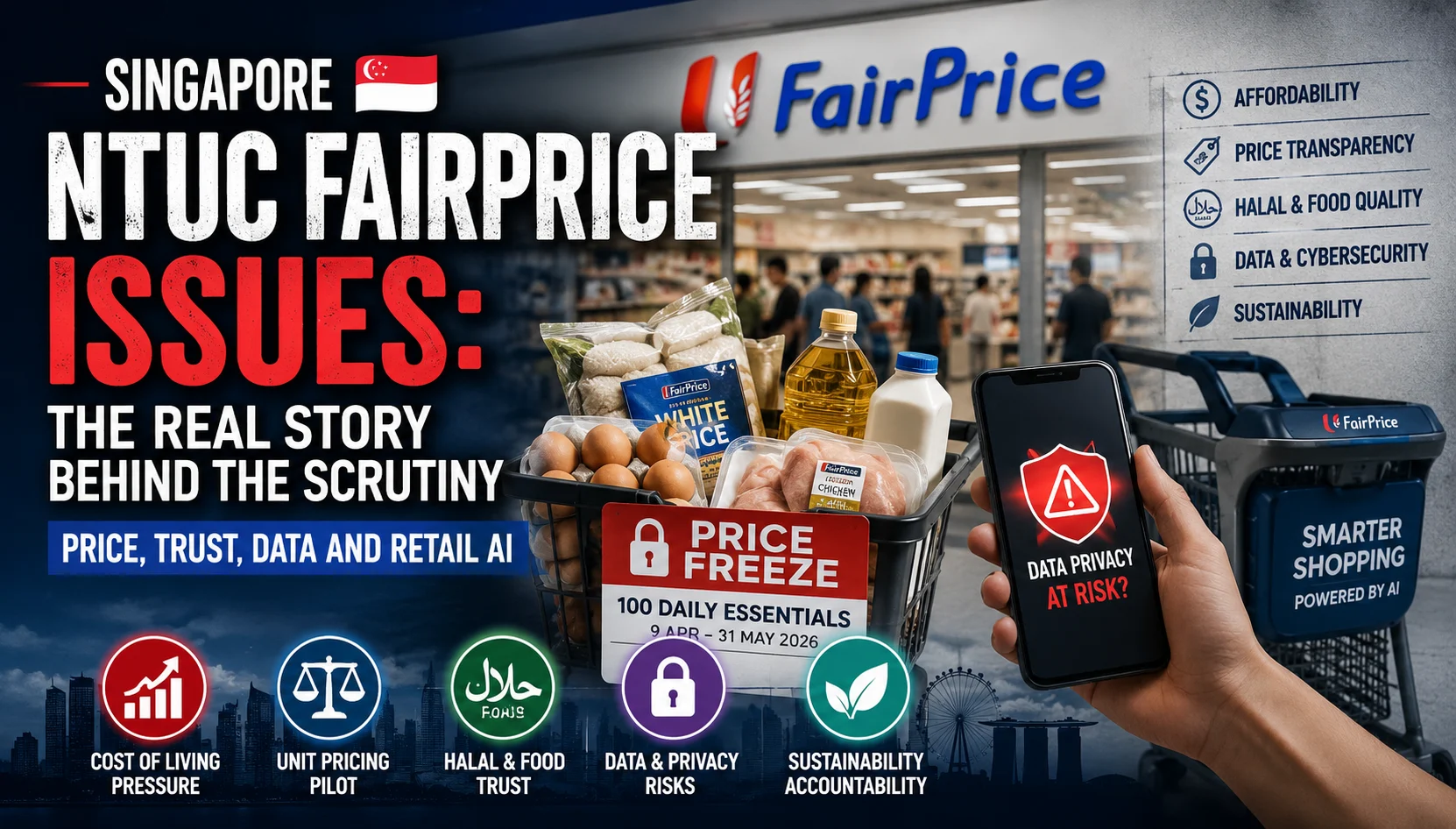
Singapore NTUC FairPrice Issues: The Real Story Behind the Scrutiny
NTUC FairPrice is not facing one single crisis. It is facing something more complicated: the heavier public scrutiny that comes with being Singapore’s everyday supermarket, cost-of-living symbol, data-rich retailer and technology testbed all at once.
NTUC FairPrice sits in a strange position in Singapore. It is a retailer, but not just a retailer. It is a co-operative with a public-facing social mission. It sells rice, eggs, chicken, diapers and kopi deals, but it also carries the expectations Singaporeans attach to affordability, fairness, trust, food safety and now even data privacy.
That is why FairPrice-related issues often feel bigger than the incident itself. A price label is not just a price label. A halal-handling mistake is not just a store-process mistake. A hacked account is not just an e-commerce fraud case. Each one touches the same deeper question: can a supermarket that asks for national trust keep operating with national-level accountability?
As of 29 May 2026, the main issues around NTUC FairPrice and FairPrice Group fall into five buckets: grocery affordability, price transparency, halal and food-quality trust, digital-data risk, and sustainability accountability.
Why FairPrice gets judged differently
FairPrice Group describes itself as Singapore’s largest retailer, with more than 570 touchpoints, more than 1 million customer interactions daily, and over 13,000 employees. It also says it began as a co-operative with a mission to keep daily essentials within reach for Singaporeans. That origin story is not a minor branding detail. It is the reason public expectations are unusually high.
A normal supermarket is judged by price, convenience and product quality. FairPrice is judged by all of that, plus whether it is still living up to its social mission.
That is the frame for the current scrutiny. Singaporeans are not only asking, “Is this cheaper?” They are asking, “Is this fair?”
Issue 1: Cost of living pressure puts FairPrice under the spotlight
The biggest FairPrice issue is still affordability. Singapore’s April 2026 Consumer Price Index rose 1.8% year on year, according to the Singapore Department of Statistics. That headline number is not extreme by recent global standards, but grocery anxiety does not depend only on CPI. It depends on what households see in baskets: eggs, milk, rice, vegetables, meat, cooking oil, detergent and children’s products.
FairPrice has responded with a familiar playbook: price freezes, return vouchers, discounts for vulnerable groups and member-based promotions.
On 8 April 2026, FairPrice Group said it would freeze prices on 100 popular daily essentials from 9 April to 31 May 2026. The list included items such as rice, oil, eggs, fresh and frozen chicken, milk and detergent. It also doubled discounts for CHAS Blue and Orange cardholders from 3% to 6% for the same period.
Later in April, FairPrice announced S$5 million worth of May Day savings for NTUC and Link members, including 50% discounts on selected essentials and 50-cent kopi or teh deals at 70 Kopitiam outlets.
The positive reading is simple: FairPrice is using scale to cushion households. The skeptical reading is also fair: short-term freezes and member discounts help, but they do not fully answer whether everyday shelf prices are consistently transparent and competitive.
That is the tension. FairPrice’s affordability work is real, but the public will keep testing it item by item.
Issue 2: Unit pricing shows that shoppers want clearer value, not just promotions
A major development in 2025 was Singapore’s unit pricing pilot. The Competition and Consumer Commission of Singapore (CCCS) and the Consumers Association of Singapore (CASE) announced that major supermarket chains, including NTUC FairPrice, would display unit prices for selected categories such as rice, meat, eggs, cooking oils, fruits and vegetables.
Unit pricing sounds boring until you are standing in front of two bottles of oil, three rice pack sizes and five brands of eggs. The point is to show the price per kilogram, litre or other unit, so consumers can compare value across different pack sizes and brands.
This matters because promotions can make value harder to judge. “Two for S$8.55” might be a good deal. It might not. A bigger pack might be cheaper per kilogram. It might not. Unit pricing gives shoppers a cleaner comparison.
For FairPrice, the pilot is not a scandal. It is an accountability signal. In a market where consumers worry about cost of living, the question is no longer whether a supermarket offers deals. The question is whether the supermarket makes the real price easy to understand.
Issue 3: The halal chicken incident became a trust test
In March 2026, FairPrice apologised after a social media post showed staff handling processed halal chicken in the pork section at its Anchorvale Village outlet. Mothership reported that Majlis Ugama Islam Singapura (MUIS) inspected the outlet and confirmed the chicken was not sold in the halal-certified section.
FairPrice said the handling practice had been stopped across all stores and that it would review internal processes. MUIS said it had taken immediate action to investigate and thanked the public for vigilance.
The incident is important because halal trust is procedural. It is not enough for a product to be correctly labelled at the end point. Customers need confidence in handling, separation, staff training and store discipline.
FairPrice’s defence — that the chicken was not sold in the halal section — matters. But the public concern also matters. When halal integrity is involved, perception and process are inseparable.
The practical lesson is blunt: supermarkets do not get unlimited benefit of the doubt on religiously sensitive handling. A single store-level lapse can become a chain-level trust issue.
Issue 4: Food quality complaints are small individually, but costly when repeated
Food-quality complaints around FairPrice often start small: a date label, a stale product, a refund process, a product removed after a customer complaint. One recent example involved discounted honey cakes sold at S$1 from the usual S$6.20. After a complaint about the “best before” date, FairPrice said the affected products were removed and customers who bought them could return them with a receipt for a full refund.
Singapore Food Agency guidance adds an important distinction: “use by” dates relate to highly perishable food and safety, while “best before” dates generally indicate when a longer-shelf-life product is expected to be at its best quality. SFA also says products should not be sold after the stated expiry date.
For supermarkets, this is not merely a technical labelling problem. It is a shelf-management problem. A customer should not need to become a food-regulation expert while buying snacks.
FairPrice’s scale makes the challenge harder. With a large network and high daily traffic, occasional errors may happen. But high scale is also why prevention matters more. The more Singaporeans rely on FairPrice, the less forgiving they will be when product checks feel inconsistent.
Issue 5: The account-hacking case pushed digital trust into the grocery aisle
FairPrice is no longer only a physical supermarket. It is also an app, a loyalty system, a payment layer and an online grocery platform. That makes cybersecurity part of the grocery experience.
In August 2025, the Singapore Police Force said a 34-year-old Singaporean man had been arrested after being deported from Thailand. SPF said he was believed to be responsible for hacking into multiple NTUC FairPrice and Zalora accounts to make fraudulent online purchases. Police said reports between July and November 2022 involved compromised NTUC FairPrice and Zalora customer accounts and fraudulent purchases amounting to at least S$25,000.
This does not prove FairPrice’s systems caused the compromise. Account takeover cases can involve reused passwords, credential stuffing or other external methods. But to customers, the distinction may feel academic. If a grocery account stores payment details, points, purchase history or delivery information, the risk feels personal.
FairPrice’s own privacy notice says it may collect data including names, dates of birth, citizenship, government-scheme eligibility, residential addresses, email addresses, mobile numbers, race, marital status and child’s date of birth, depending on the relationship and service. It also says MyInfo through Singpass can be used via the FairPrice Group mobile app with consent.
That makes data minimisation and clear consent crucial. A retailer can offer smoother discounts through verified profiles. But the more personal the data, the higher the trust burden.
Issue 6: AI shopping carts are convenient, but they raise new questions
FairPrice is expanding its “Store of Tomorrow” programme. In April 2026, FairPrice Group said it would roll out digital innovations developed with Google Cloud AI across its network by end-2026. These include smart shopping carts, digital price cards, a hybrid physical-digital ShopBeyond format and Grocer Genie, an AI-powered staff app.
CNA reported that more than 1,300 smart trolleys would be rolled out across 48 FairPrice Xtra and Finest outlets by end-2026. The carts are integrated with the FairPrice Group app and can help shoppers navigate aisles, receive personalised promotions, scan items and pay while shopping. FairPrice said checkout times at Punggol Coast Mall had fallen to an average of 36 seconds since implementation.
That is useful. Nobody loves a checkout queue.
But retail AI changes the supermarket relationship. The store is no longer just displaying products; it is reading baskets, guiding shoppers, personalising offers and potentially shaping decisions in real time.
The issue is not whether AI belongs in supermarkets. It probably does. The issue is whether customers clearly understand what data is being used, how promotions are personalised, and whether convenience quietly nudges them to spend more.
A fair AI supermarket needs more than fast carts. It needs explainable offers, privacy-respecting defaults and easy opt-outs.
Issue 7: Plastic-bag fees created a transparency question
Singapore’s disposable carrier bag charge is another area where FairPrice appears in a broader national debate. Since 3 July 2023, larger supermarket operators with annual turnover above S$100 million have been required to charge at least five cents for each disposable carrier bag.
CNA reported in February 2026 that FairPrice Group, including Cheers, collected S$1.68 million from the bag charge in the second half of 2023 and S$3.41 million in 2024. CNA also reported that operators are required to publish how much they collect and how the proceeds are used, though the National Environment Agency strongly encourages donations to environmental and social causes rather than mandating them.
The public issue is not whether charging for plastic bags is defensible. Reducing waste is a legitimate policy goal. The issue is whether consumers understand where the money goes.
FairPrice’s proceeds went to a mix of FairPrice Foundation programmes, electric-vehicle infrastructure, packaging consultancy and WWF-Singapore conservation and education efforts, according to CNA’s review. The problem is that “mixed use” always requires clear explanation. If shoppers feel a bag fee is a sustainability levy, they will expect visible sustainability outcomes.
The bigger pattern: FairPrice is becoming a trust platform
The scattered issues around FairPrice look unrelated at first. Price freezes. Halal handling. Expired or date-sensitive products. Account hacking. MyInfo. Smart carts. Plastic-bag proceeds.
But they connect through one word: trust.
FairPrice is becoming a trust platform for everyday life. It touches food, household budgeting, public schemes, identity verification, loyalty data, sustainability behaviour and AI-assisted shopping. That makes it more powerful, more useful and more exposed.
The old supermarket bargain was simple: give customers decent prices and reliable shelves.
The new bargain is harder: give customers decent prices, clear value, safe food, respectful handling, secure accounts, honest data use, transparent fees and technology that helps rather than manipulates.
What FairPrice needs to do next
FairPrice does not need to respond to every online complaint as if it is a national emergency. That would be impossible and probably unhealthy.
But it does need a clearer public standard in five areas:
- Price clarity: expand unit pricing, make promotions easier to compare, and avoid deal mechanics that require too much mental arithmetic.
- Store-process discipline: treat halal handling, date checks and product removal as trust-critical operations, not backroom details.
- Refund and complaint consistency: make the resolution path simple across outlets and online channels.
- Data restraint: collect only what is needed, explain MyInfo and app data use plainly, and make consent feel meaningful rather than buried.
- AI transparency: explain how smart carts and personalised offers work, what data they use, and how shoppers can opt out.
Bottom line
The FairPrice issue is not that Singapore’s largest supermarket is suddenly unreliable. The issue is that FairPrice has outgrown the old definition of a supermarket.
It is now a grocery chain, social enterprise, payments interface, loyalty network, food-service operator, sustainability actor and AI retail lab. That makes its mission more relevant — and its mistakes more visible.
FairPrice’s next challenge is not just to keep prices fair. It is to make fairness visible in every system shoppers touch.
FAQ
What are the main NTUC FairPrice issues in Singapore in 2026?
The main issues are grocery affordability, price transparency, halal-handling trust, food-quality checks, account security, data privacy, AI-powered shopping and transparency over sustainability-linked charges such as plastic-bag fees.
Did FairPrice have a halal chicken controversy?
Yes. In March 2026, FairPrice apologised after a social media post showed processed halal chicken being handled in the pork section at its Anchorvale Village outlet. MUIS inspected the outlet and said the chicken was not sold in the halal-certified section.
Is FairPrice freezing prices because of inflation?
FairPrice said in April 2026 that it would freeze prices on 100 popular essentials from 9 April to 31 May 2026 amid global volatility and cost pressures. The move included staples such as rice, oil, eggs, poultry, milk and detergent.
What is unit pricing, and why does it matter for FairPrice shoppers?
Unit pricing shows the price per unit of measurement, such as per kilogram or litre. It matters because it helps shoppers compare real value across brands, pack sizes and promotions.
Why are data privacy questions relevant to FairPrice?
FairPrice’s app, loyalty system, MyInfo verification and smart-cart rollout make customer data part of the shopping experience. That creates convenience, but it also raises questions about consent, personalisation, account security and data minimisation.
Sources
- FairPrice Group homepage — FairPrice Group. Used for: company scale, mission and business context.
- Standing With Singaporeans: FairPrice Group moves fast to lock prices on key essentials — FairPrice Group, 8 April 2026. Used for: price freeze and CHAS discount details.
- FairPrice Group to provide NTUC and Link members with $5 million worth of savings — FairPrice Group, 30 April 2026. Used for: May Day savings and discount initiatives.
- Latest News & Data: Consumer Price Index — Singapore Department of Statistics, accessed 29 May 2026. Used for: April 2026 CPI.
- Unit Pricing Pilot Launches at Major Supermarkets from September 2025 — Competition and Consumer Commission of Singapore, 27 August 2025. Used for: unit pricing pilot details.
- FairPrice apologises after chicken handled in pork section at Sengkang outlet — Mothership, 27 March 2026. Used for: halal-handling incident and MUIS response.
- Discounted honey cakes at S$1 from usual S$6.20 at FairPrice removed after complaint — Mothership, 27 April 2026. Used for: date-label/product-quality incident.
- Understanding Food & Nutrition Labels Before Purchase — Singapore Food Agency. Used for: expiry-date guidance.
- Singapore Hacker Deported From Thailand To Be Charged For Computer Misuse Act Offences — Singapore Police Force, 25 August 2025. Used for: FairPrice/Zalora account-hacking case.
- Privacy Notice — FairPrice Group, effective 2 June 2025. Used for: personal data and MyInfo collection context.
- FairPrice to roll out smart shopping carts with self-checkout, navigation features by end-2026 — CNA, 23 April 2026. Used for: smart carts and Store of Tomorrow rollout.
- FairPrice Group to bring heartland grocery runs into the future with island-wide expansion of Store of Tomorrow programme — FairPrice Group, 23 April 2026. Used for: official AI retail rollout details.
- Supermarket plastic bag charge raises millions of dollars, but questions emerge over fund usage — CNA, 6 February 2026. Used for: plastic-bag fee proceeds and transparency issue.