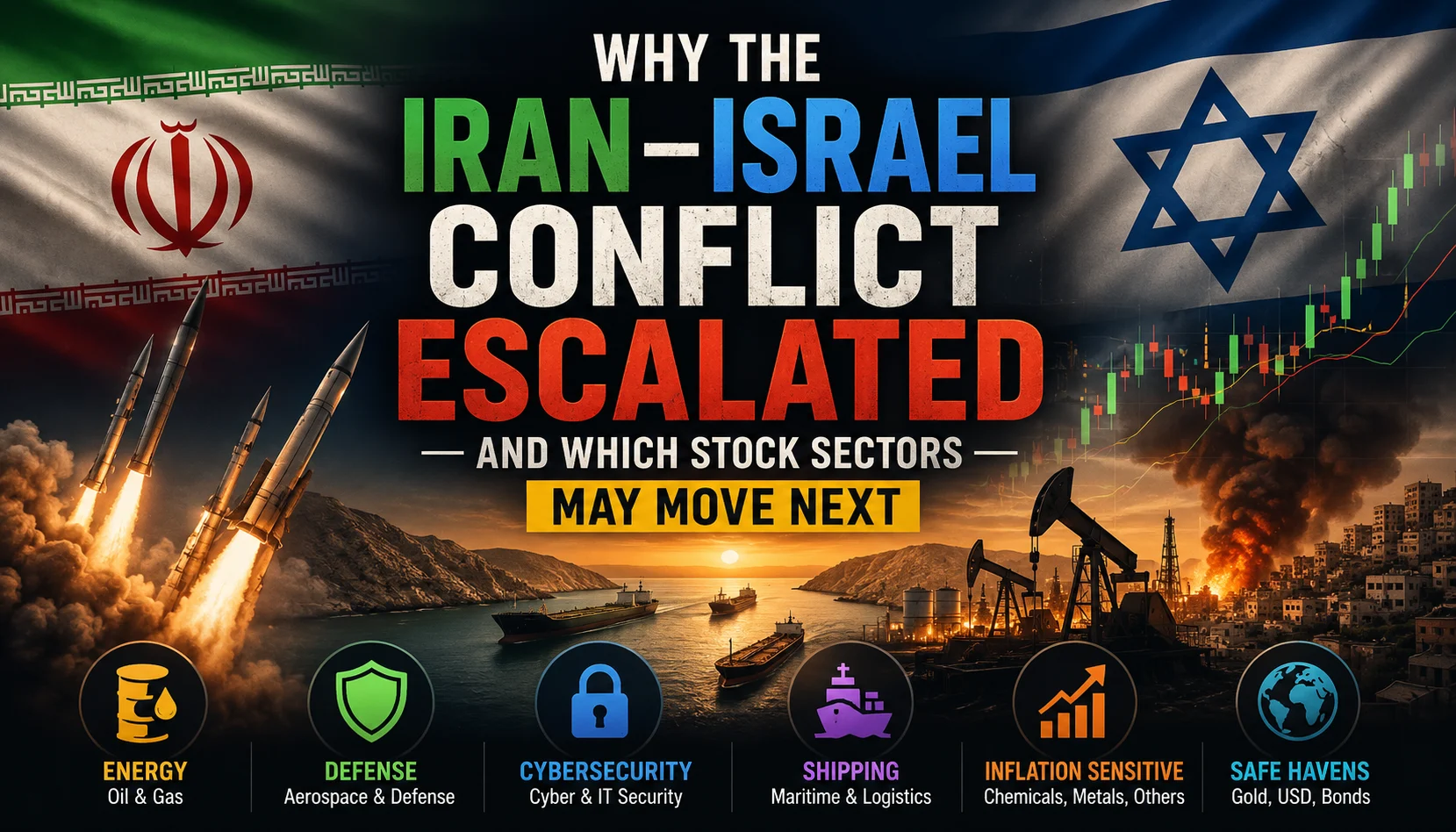
Why the Iran–Israel Conflict Escalated — and Which Stock Sectors May Move Next
The Iran–Israel conflict is not only a military story. For markets, it is a pricing story about nuclear risk, energy chokepoints, sanctions, shipping disruption, inflation, and how quickly investors rotate from fear to earnings.
This article is for general information only. It is not investment, legal, tax, or geopolitical advice. Market forecasts are inherently uncertain, especially during an active conflict. Always check current prices, filings, and local regulations before making financial decisions.
The short answer
The latest Iran–Israel escalation is rooted in five linked forces: Iran’s nuclear program, Israel’s pre-emptive security doctrine, Iran’s missile and proxy network, failed diplomacy, and the strategic importance of the Strait of Hormuz.
The market impact is equally layered. The first winners in a conflict shock are usually oil, energy producers, safe-haven currencies, and sometimes defense shares. But the second phase is messier. If energy prices stay high, airlines, chemicals, automakers, consumer discretionary companies, and energy-importing economies face margin pressure. If diplomacy improves, the “war premium” in energy and defense can reverse quickly.
As of May 28, 2026, the next likely sector rotation depends less on the headline “war or peace” and more on one practical question: does the Strait of Hormuz normalize, remain restricted, or deteriorate further?
What happened?
The current confrontation is best understood as a multi-stage escalation rather than one isolated event.
In June 2025, the International Atomic Energy Agency (IAEA) Board of Governors adopted a resolution finding that Iran’s failures to cooperate on undeclared nuclear material and activities constituted non-compliance with its safeguards obligations. The IAEA also said it could not verify that there had been no diversion of safeguarded nuclear material to nuclear weapons or other explosive devices. IAEA Board of Governors resolution, GOV/2025/38
The following day, Israel launched strikes on Iranian nuclear, missile, and military targets, saying it was acting to prevent Iran from reaching a nuclear weapons capability. Iran retaliated with missile attacks against Israel. Reuters described the June 2025 round as a direct exchange in which Israel hit nuclear sites and Iran retaliated. Reuters, June 13, 2025
The conflict later widened. Reuters reported that U.S. and Israeli strikes began again on February 28, 2026, and that by late May the war had caused major disruption around the Strait of Hormuz. On May 28, 2026, Reuters reported new exchanges between the United States and Iran after a U.S. strike near Bandar Abbas and Iranian retaliation, with oil prices rebounding and equities weakening on renewed escalation fears. Reuters, May 28, 2026
The important point for global readers is this: the conflict moved from a nuclear-security confrontation into an energy-and-shipping crisis. That is why it matters so much for stock sectors far outside the Middle East.
Why did the conflict escalate?
1. The nuclear issue became the trigger
Iran says its nuclear program is peaceful. Israel, the United States, and several Western governments have long argued that Iran’s enrichment activity and lack of full transparency create a weapons risk.
The IAEA’s June 2025 resolution was a key inflection point. It did not say Iran had built a nuclear weapon. It said Iran had failed to provide the cooperation needed for the agency to verify the exclusively peaceful nature of the program. That distinction matters. Markets do not need certainty to reprice risk; they need a credible path to a worse outcome.
The IAEA Director General later told the UN Security Council that Fordow was Iran’s main enrichment location for uranium enriched to 60%, and that more than 400 kilograms of Iran’s stockpile was enriched up to 60% U-235. He emphasized the need for inspectors to verify that all relevant material remained accounted for. IAEA statement to the UN Security Council, June 20, 2025
For Israel, that level of enrichment is not a normal diplomatic disagreement. It is interpreted through the lens of national survival. For Iran, outside pressure on the nuclear program is interpreted through sovereignty, deterrence, and regime security. That combination is combustible.
2. Diplomacy failed at the wrong moment
Conflicts often escalate not when diplomacy is absent, but when diplomacy almost works and then collapses.
A UK House of Commons Library briefing noted that the 2026 attacks followed the failure of indirect negotiations in February 2026 on a new agreement to curtail Iran’s nuclear program. It also described Iran’s regional and internal position as weakened by economic stress, protests, and damage to allies and defenses. UK House of Commons Library, April 2026
That timing matters. When diplomacy stalls and one side believes the other is using talks to buy time, the incentive for pre-emptive action rises.
3. The conflict is not only Iran versus Israel
The conflict has a wider cast: the United States, Hezbollah, Gulf states, international shipping firms, energy importers, and sanctioning authorities. That makes de-escalation harder because each party has different red lines.
Iran’s regional network has historically given Tehran strategic depth. Israel’s military actions since 2023 weakened several Iran-aligned actors, but did not remove the logic of proxy escalation. The result is a regional security system in which a strike in one place can trigger retaliation somewhere else: Lebanon, the Gulf, Iraq, Syria, Yemen, cyberspace, or shipping lanes.
4. The Strait of Hormuz turned military risk into macro risk
The Strait of Hormuz is the narrow waterway connecting the Persian Gulf with global sea routes. It is not just another shipping lane. The U.S. Energy Information Administration estimated that in 2024, oil flows through the strait averaged about 20 million barrels per day, equal to roughly 20% of global petroleum liquids consumption. It also estimated that about one-fifth of global LNG trade transited the strait in 2024. U.S. EIA, June 2025
That is why the conflict matters to stock markets in Tokyo, Seoul, Mumbai, London, Frankfurt, and New York. A shock at Hormuz is not simply a Middle Eastern event. It is a global input-cost shock.
In March 2026, the International Energy Agency said its 32 member countries agreed to make 400 million barrels of oil from emergency reserves available, calling it the largest-ever IEA stock release. The agency said conflict beginning on February 28 had impeded oil flows through the Strait of Hormuz and that export volumes of crude and refined products were less than 10% of pre-conflict levels at that point. International Energy Agency, March 11, 2026
That single data point explains much of the market reaction: oil is not only a commodity; it is a tax on nearly every business model.
5. Sanctions and maritime control added another layer
On May 27, 2026, the U.S. Office of Foreign Assets Control added the Persian Gulf Strait Authority to its Specially Designated Nationals list, identifying it as linked to the Islamic Revolutionary Guard Corps. OFAC, May 27, 2026
This matters for equities because sanctions turn physical disruption into compliance risk. Shipping companies, insurers, banks, commodity traders, and industrial importers must assess not only whether vessels can move, but also whether a transaction exposes them to penalties.
How markets have reacted so far
The first market reaction was classic: oil rose, risk assets weakened, and investors bought safety.
Reuters reported that on June 13, 2025, Wall Street ended sharply lower after Iran retaliated against Israel’s strikes. The S&P 500 fell 1.13%, the Nasdaq fell 1.30%, and the Dow fell 1.79%. Energy stocks rose with oil, airline stocks fell on fuel-cost concerns, and U.S. defense firms rose. Reuters, June 13, 2025
But the market’s second phase has been less simple. By May 2026, Reuters described a more divided picture: oil and the U.S. dollar had benefited, energy importers were major losers, and bond yields had risen as investors worried about inflation. Reuters, May 27, 2026
Reuters also reported that the conflict had already cost global companies at least $25 billion, based on a review of corporate statements. Airlines represented the largest share of quantified war-related costs, and companies in industries from consumer goods to autos and materials warned of higher fuel, shipping, petrochemical, and input costs. Reuters, May 18, 2026
The paradox is that broad U.S. equities have not collapsed. Reuters’ May 2026 poll of market strategists still expected the S&P 500 to finish 2026 slightly above current levels, helped by strong earnings and AI-related momentum, even as higher energy prices and inflation created risk. Reuters, May 27, 2026
That tells us something important: the conflict is not replacing the AI earnings cycle. It is competing with it.
Sector outlook: where the next moves may come from
The following outlook is not a stock recommendation. It is a framework for understanding which sectors are most sensitive to the next phase of the conflict.
| Sector | Likely direction if conflict persists | Why it may move | Key risk |
|---|---|---|---|
| Energy producers | Positive bias | Higher oil and gas prices support revenue and cash flow | Peace headlines or reserve releases can quickly compress the risk premium |
| LNG and gas infrastructure | Positive bias | Buyers seek supply security outside disrupted routes | Project timelines, regulation, and contract exposure matter |
| Defense and aerospace | Selective positive bias | Governments may prioritize air defense, missiles, drones, interceptors, and replenishment | Valuations may already include conflict premium |
| Cybersecurity | Positive medium-term bias | Conflict raises risk to critical infrastructure, defense contractors, energy, finance, and transport | Cyber budgets may rise slowly; not all vendors benefit equally |
| Shipping, tankers, and marine services | Mixed but volatile | Scarcity of safe routes can raise rates and insurance demand | Sanctions, vessel risk, and route disruption can destroy margins |
| Gold miners and precious metals | Mixed | Safe-haven demand can help | Strong dollar and higher real rates can hurt gold |
| Airlines and travel | Negative bias | Jet fuel, rerouting, and demand uncertainty pressure margins | Fuel hedging can cushion some companies |
| Chemicals and materials | Negative bias | Higher oil and petrochemical input costs squeeze margins | Pricing power varies sharply by company |
| Automakers and consumer discretionary | Negative bias | Energy costs hit consumers and supply chains | Premium brands may resist margin pressure better |
| AI semiconductors and data centers | Positive if earnings dominate | Secular AI demand remains powerful | Higher rates and energy costs can pressure valuations |
The next likely winners
1. Energy: still the cleanest conflict-linked trade
Energy is the most direct beneficiary of prolonged disruption. If Hormuz flows remain impaired, oil and gas producers with lower geopolitical exposure and strong balance sheets are likely to remain in focus.
But this is also the sector most vulnerable to a peace headline. A credible deal that reopens the Strait of Hormuz could cut the war premium quickly. That does not mean energy becomes unattractive; it means the trade changes from “geopolitical spike” to “cash-flow durability.”
What to watch: Brent crude, physical cargo spreads, tanker-tracking data, IEA emergency stock updates, and whether Asian refiners can secure alternative supply.
2. LNG and energy security infrastructure
The LNG story is slightly different from crude oil. If Gulf shipping remains uncertain, countries that rely on imported energy will reassess supply security. That can support LNG infrastructure, storage, pipelines, regasification terminals, and power-grid investment.
The EIA’s estimate that around one-fifth of global LNG trade transited Hormuz in 2024 explains why Asian buyers are especially exposed. Japan, South Korea, China, and India are not passive observers; they are demand centers whose energy costs feed directly into inflation and industrial margins. U.S. EIA, June 2025
What to watch: Asian LNG spot prices, Qatar export flows, long-term contract announcements, and power-utility fuel cost pass-through rules.
3. Defense: structural demand, but not a guaranteed rally
Defense is the obvious answer, but the obvious answer is not always the best trade.
Reuters reported in April 2026 that U.S. defense stocks had declined even as the Iran war dragged on, after an early surge. Investors cited early positioning, high valuations, long output cycles, and budget uncertainty. Reuters, April 2, 2026
The more durable opportunity may be narrower: air defense, missile interceptors, electronic warfare, drones, surveillance, naval defense, and ammunition replenishment. A broad defense ETF may not capture the same economics as a company with direct exposure to the specific systems being consumed.
What to watch: government budget authorizations, backlog growth, book-to-bill ratios, production capacity, and margin guidance.
4. Cybersecurity: the quiet second-order sector
Military conflict increasingly creates digital spillover. The Canadian Centre for Cyber Security warned in March 2026 that Iran would very likely use its cyber program to respond to U.S. and Israeli combat operations, including possible cyberattacks against critical infrastructure, information operations, harassment, and activity against diaspora communities. It also noted Iranian actors’ focus on sectors such as aerospace, energy, defense, security, and telecommunications. Canadian Centre for Cyber Security, March 2026
This does not mean every cybersecurity stock rallies immediately. Cybersecurity is a budget cycle. The market usually rewards vendors with visible demand in identity, endpoint defense, cloud security, industrial control systems, threat intelligence, and incident response.
What to watch: critical-infrastructure advisories, ransomware activity, government cyber spending, and earnings commentary from security vendors.
5. Shipping and marine insurance: high upside, high danger
Shipping is not simply “good” or “bad” in a Hormuz crisis. Some tanker owners can benefit from higher rates, longer routes, and scarcity. Insurers and risk-service providers may see higher pricing. But ships can also be delayed, rerouted, sanctioned, attacked, or stranded.
Reuters’ corporate-cost analysis noted that the conflict has driven up shipping costs, squeezed supplies of raw materials, and disrupted trade routes. Reuters, May 18, 2026
The sector is therefore tactical, not clean. The best-positioned companies are those with strong compliance systems, flexible fleets, limited exposure to sanctioned flows, and pricing power.
What to watch: war-risk premiums, tanker day rates, vessel-tracking data, OFAC updates, and port congestion.
The likely losers if the conflict drags on
Airlines
Airlines are usually among the first victims of a Middle East energy shock. Jet fuel is a major operating cost, and conflict can also force route changes. Reuters reported that airlines accounted for the largest share of quantified war-related corporate costs in its May 2026 analysis. Reuters, May 18, 2026
Some carriers hedge fuel better than others, but a prolonged oil shock usually narrows the margin for error.
Chemicals, tires, plastics, and industrial materials
Petrochemicals sit close to the oil shock. When crude, naphtha, LNG, and shipping costs rise, chemicals and materials companies either pass costs to customers or absorb the margin hit. Reuters reported that nearly 40 companies in industrials, chemicals, and materials said they would raise prices due to Middle Eastern petrochemical exposure. Reuters, May 18, 2026
Consumer discretionary and autos
Consumers feel oil shocks through fuel, utility bills, food logistics, and inflation expectations. Automakers also face input-cost and supply-chain pressure. The effect is not immediate for every company, but it shows up through weaker demand, higher financing costs, and lower pricing power.
Energy-importing economies
Countries and regions dependent on imported Middle Eastern energy face the hardest macro trade-off: support growth, fight inflation, or protect currencies. That matters for equity sectors in Asia and Europe, where energy pass-through can hit industrial margins faster than in more energy self-sufficient markets.
Scenario map: three market paths from here
| Scenario | What happens | Likely sector leaders | Likely laggards |
|---|---|---|---|
| De-escalation and Hormuz reopening | Shipping normalizes; oil risk premium fades | Airlines, consumer discretionary, industrials, Asian importers, selected tech | Energy producers, oil services, tactical defense trades |
| Frozen conflict | No full war expansion, but Hormuz remains constrained | Energy, LNG infrastructure, cybersecurity, selected defense | Airlines, chemicals, autos, low-margin retailers |
| Wider escalation | Attacks spread to energy infrastructure, shipping, or regional bases | Oil and gas, defense, cybersecurity, dollar-linked safe havens, some shipping niches | Global equities, airlines, travel, emerging-market importers, cyclicals |
The base case for many investors is not “peace” or “world war.” It is an uncomfortable middle: limited diplomacy, periodic strikes, expensive energy, and higher compliance risk. That is the environment where sector dispersion becomes more important than index direction.
The part investors often miss
The first-order trade is easy: conflict means oil up, airlines down, defense up.
The better question is: what happens after everyone already knows that?
Three second-order effects matter more:
- Margin compression arrives with a delay. Reuters noted that many companies had not yet fully reflected the war’s cost in earnings. That means negative revisions may continue after the headline shock fades.
- Defense stocks are not pure fear gauges. Procurement cycles, budgets, production capacity, and valuations decide performance after the first rally.
- AI remains a competing market narrative. Semiconductor and data-center stocks can keep rising if earnings surprise positively, even while geopolitical risk weighs on the broader market.
That is why a portfolio-level view matters. A conflict can hurt the index but help a sector. It can lift oil but hurt chemical producers. It can raise defense spending but not immediately raise defense margins.
Practical monitoring checklist
For a global investor, the most useful dashboard is simple:
- Strait of Hormuz flows: tanker crossings, export volumes, insurance rates, port disruptions.
- Oil and LNG prices: Brent, WTI, Asian LNG spot prices, refined product spreads.
- Policy response: IEA stock releases, sanctions, naval deployments, ceasefire terms.
- Inflation expectations: bond yields, central-bank guidance, breakeven inflation.
- Corporate guidance: airlines, chemicals, autos, consumer staples, industrials, and energy producers.
- Cyber alerts: government advisories and attacks on critical infrastructure.
- Defense budgets: supplemental appropriations, missile-defense orders, and replenishment contracts.
The best signal is not one headline. It is the combination of physical flows, policy action, and earnings guidance.
FAQ
What is the main cause of the Iran–Israel conflict?
The main cause is the collision between Iran’s nuclear and regional-security ambitions and Israel’s determination to prevent Iran from gaining a nuclear weapons capability. The immediate escalation was shaped by IAEA non-compliance findings, failed diplomacy, Israeli and U.S. strikes, Iranian retaliation, and disruption around the Strait of Hormuz.
Why does the Strait of Hormuz matter so much?
The Strait of Hormuz is one of the world’s most important energy chokepoints. The EIA estimated that oil flows through the strait averaged about 20 million barrels per day in 2024, roughly 20% of global petroleum liquids consumption, and that around one-fifth of global LNG trade also passed through it. Disruption there raises energy costs globally.
Which stock sectors usually benefit from an Iran–Israel escalation?
The most direct beneficiaries are energy producers, oilfield services, LNG-linked infrastructure, selected defense companies, and cybersecurity firms. Shipping and marine insurance can also benefit tactically, but they carry unusually high operational and sanctions risk.
Which sectors are most at risk?
Airlines, travel, autos, chemicals, consumer discretionary, low-margin industrials, and energy-importing economies are most exposed to prolonged high energy prices and shipping disruption. The damage often appears with a delay through earnings revisions and margin pressure.
Are defense stocks guaranteed to rise during the conflict?
No. Defense stocks can rally early, but Reuters reported that U.S. defense shares later declined even as the war dragged on because investors had already priced in a conflict premium and worried about valuations, long production cycles, and budget uncertainty. The more durable opportunities are likely to be selective rather than sector-wide.
Could technology stocks still rise despite the conflict?
Yes. The conflict is competing with, not replacing, the AI earnings cycle. Reuters reported that strong AI-related momentum and corporate earnings helped support U.S. equities even as the war lifted energy prices and inflation risk. However, higher rates and energy costs can still pressure valuations.
What is the single most important indicator to watch next?
Watch whether commercial flows through the Strait of Hormuz normalize. If they do, energy and defense risk premiums may fade. If flows remain restricted or deteriorate, energy, LNG, cybersecurity, and selected defense themes are more likely to stay in focus.
Sources
- IAEA Board of Governors, GOV/2025/38: NPT Safeguards Agreement with the Islamic Republic of Iran — Official IAEA resolution, June 12, 2025. Used for: safeguards non-compliance and nuclear verification context.
- IAEA Director General Grossi’s Statement to the UN Security Council on the Situation in Iran — Official IAEA statement, June 20, 2025. Used for: nuclear-site damage, enrichment, and inspection concerns.
- Reuters: Israel hit Iran’s nuclear sites and killed its top military commanders, Iran retaliated — Reuters, June 13, 2025. Used for: immediate Israel–Iran escalation.
- Reuters: Iran and US trade air strikes after Trump dismisses report of Hormuz deal — Reuters, May 28, 2026. Used for: latest escalation, ceasefire fragility, and market reaction.
- U.S. Energy Information Administration: Amid regional conflict, the Strait of Hormuz remains critical oil chokepoint — Official EIA analysis, June 16, 2025. Used for: Hormuz oil and LNG flow data.
- International Energy Agency: IEA Member countries to carry out largest ever oil stock release — Official IEA press release, March 11, 2026. Used for: emergency oil stock release and Hormuz disruption.
- OFAC: Iran-related Designation; Counter Terrorism Designation — U.S. Treasury/OFAC, May 27, 2026. Used for: Persian Gulf Strait Authority sanctions.
- UK House of Commons Library: Israel/US–Iran conflict 2026: Background and UK response — UK parliamentary briefing, April 24, 2026. Used for: conflict background, diplomacy, and regional context.
- Reuters: Iran war splits global markets into clear winners and losers — Reuters, May 27, 2026. Used for: market winners/losers, oil, dollar, and energy-importer impact.
- Reuters: Iran war saddles global companies with $25 billion bill — Reuters, May 18, 2026. Used for: corporate cost impact across airlines, autos, chemicals, and consumer sectors.
- Reuters: U.S. defense stocks see no Iran war lift after early surge — Reuters, April 2, 2026. Used for: defense-sector nuance and valuation risk.
- Reuters: S&P 500 forecast to end year slightly higher even as war drags on — Reuters, May 27, 2026. Used for: U.S. equity outlook, AI earnings offset, inflation risk.
- Canadian Centre for Cyber Security: Iranian Cyber Threat Response to US/Israel strikes — Government of Canada, March 2, 2026. Used for: cybersecurity risk and likely Iranian cyber responses.